

Whether you are a homeowner taking on your first major renovation or a general contractor managing multiple trades, the path to a successful construction project runs through one place: a solid, well-documented construction plan. Without it, you face cost surprises that erode your budget, schedule gaps that stall your crew, and coordination failures that result in rework and disputes.
Learning how to plan a construction project is not reserved for seasoned project managers. With the right framework, the right tools, and an understanding of common pitfalls, any project team can move from a vague idea to a confident execution plan before the first shovel hits the ground.
In this guide, you will learn:
- A step-by-step construction planning process you can apply immediately
- How to build a realistic budget, timeline, and permit strategy
- The most common planning mistakes and how to avoid them
What is construction project planning?
Construction project planning is the structured process of defining, organizing, and coordinating every element of a build before work begins. It covers the project’s full scope, budget, schedule, resources, and risk – and it serves as the operational blueprint that guides every decision through each construction phase, from groundbreaking to final inspection..
At its core, construction planning answers 4 foundational questions:
- What needs to be built? (scope and objectives)
- How much will it cost? (budget and cost estimation)
- How long will it take? (scheduling and milestones)
- Who is responsible for each part? (resources and subcontractors)
Construction planning and design work together during the preconstruction phase. Design decisions directly influence cost estimates and schedule lengths, which is why early alignment between architects, engineers, and contractors is essential.
In industrial construction planning, the same principles apply at a larger scale, with greater emphasis on regulatory compliance, equipment logistics, and workforce management.
Why construction planning fails (and what it actually costs)
Understanding why planning breaks down is just as valuable as knowing what good planning looks like. The same failure modes appear across project types, from single-family home additions to major commercial developments.
Common reasons planning fails
Undefined project scope: When the project’s boundaries are not clearly documented, everyone makes assumptions. Those assumptions rarely align, leading to scope creep, change orders, and cost overruns.
Unrealistic budgets: Budgets built on wishful thinking rather than real market pricing guarantee financial stress during construction. This often forces value-engineering decisions that compromise quality.
Poor scheduling: Schedules that do not account for permit timelines, material lead times, or subcontractor availability are not schedules, they are optimistic guesses. They fail at first contact with reality.
Lack of coordination: Construction involves dozens of interconnected tasks performed by multiple parties. When those parties do not communicate effectively, work gets done out of sequence, trades interfere with each other, and rework follows.
What poor planning actually costs
The financial consequences of inadequate construction planning are well-documented across the industry:
Schedule delays: Projects without solid plans run weeks or months behind schedule. Each additional week of construction adds labor costs, equipment rental fees, and financing charges.
Budget overruns: Industry research consistently shows that poorly planned projects experience cost overruns of 10–30% or more above original estimates.
Rework and material waste: Work performed out of sequence or based on incomplete information frequently needs to be redone. Rework is one of the highest-cost and most preventable sources of waste in construction.
Contractor disputes: Unclear contracts, undefined responsibilities, and scope disagreements escalate quickly into costly disputes that damage relationships and, in some cases, end in litigation.
Learn more: Construction Budget: What You Need to Know
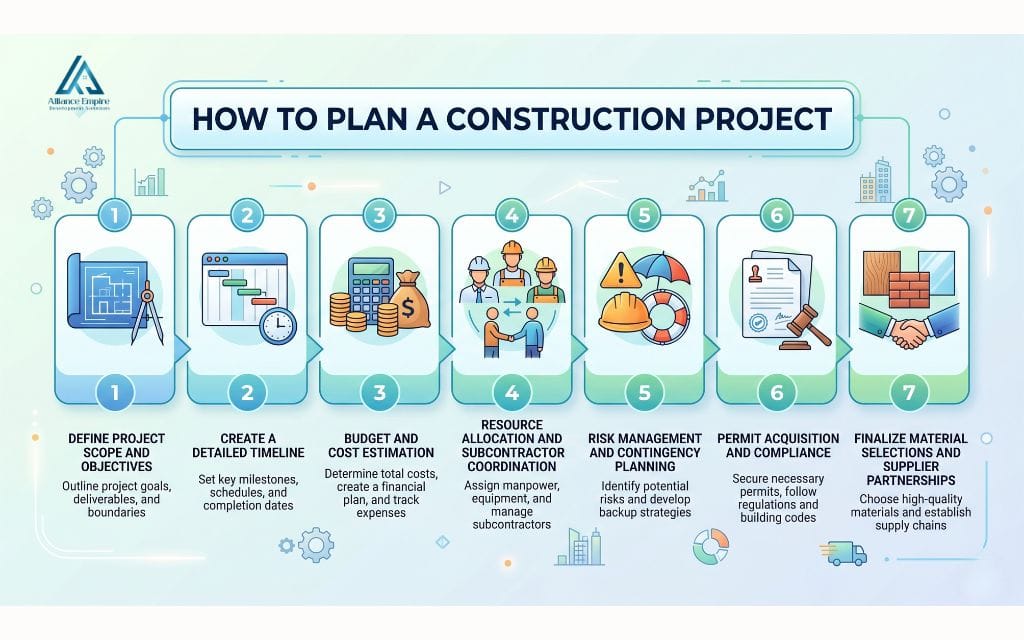
How to plan a construction project
This section lays out the core construction project planning steps that experienced project managers rely on. Follow them in order to build a plan that is both thorough and actionable.
Step 1: Define project scope and objectives
Every strong construction plan begins with a clear, written definition of what you are building and why. Scope definition eliminates ambiguity and gives every team member a shared understanding of the end goal.
Key elements to document during scope definition:
- Project goals and requirements: What is the purpose of the structure? What functional requirements must it meet? For commercial builds, this often includes occupancy type, code classifications, and ADA compliance requirements.
- Design expectations: What does the finished product look like? Align on architectural style, material preferences, square footage, layout, and any special features before engaging contractors.
- Timeline targets: Establish an expected completion date and any fixed deadlines such as a business opening date, lease expiration, or seasonal construction window.
Document your scope in writing and get sign-off from all key stakeholders before moving forward. Undefined or shifting scope is one of the most common reasons construction projects run over budget.
Step 2: Create a detailed timeline
A realistic schedule is the backbone of any well-executed build. Without it, subcontractors overlap, materials arrive late, and inspections get missed. Planning a construction project without a structured timeline is like building without a blueprint.
Steps for building a solid project schedule:
- Break the project into phases: Typical construction phases include preconstruction, site preparation, foundation, framing, MEP (mechanical, electrical, plumbing) rough-in, insulation, drywall, finish work, and inspections.
- Define milestones: Milestones are clearly measurable checkpoints such as “permit approved,” “foundation poured,” or “building dried in.” They keep the team focused and provide early warning when the schedule slips.
- Identify the critical path: The critical path is the longest sequence of dependent tasks that directly determines the project’s end date. Any delay on the critical path delays the entire project. Use Critical Path Method (CPM) scheduling to map this out and identify where you have scheduling flexibility.
Step 3: Budget and cost estimation
Accurate cost estimation is where many projects begin to unravel. Underestimating costs at the planning stage creates financial pressure that leads to cut corners, disputes with contractors, and incomplete work.
How to build a reliable construction budget:
- Estimate all cost categories: Include hard costs (materials, labor, equipment), soft costs (design fees, permits, inspections, insurance), and financing costs if applicable.
- Get multiple bids: Obtain at least three contractor bids for major work scopes. Bids reveal market pricing and help identify outliers in either direction.
- Include a contingency buffer: Industry standard practice recommends a contingency of 10 – 15% of total project cost for new construction and 15 – 20% for renovations. Hidden conditions, design changes, and material price fluctuations make contingency essential, not optional.
- Monitor costs continuously: Budget tracking should be a live process throughout construction, not a one-time exercise. Compare actual spend against estimated costs at each project milestone.

Step 4: Resource allocation and subcontractor coordination
Construction projects require people, equipment, and materials working in the right sequence. Effective resource allocation and subcontractor coordination ensures that no one is standing around waiting and that work flows efficiently from one phase to the next.
- Assign roles and responsibilities: Clearly define who is responsible for each work scope, decision, and communication thread. Ambiguous ownership leads to accountability gaps and delays.
- Coordinate subcontractors: Confirm subcontractor availability before awarding contracts. Vet their licensing, insurance, and references. Create a coordination schedule that maps each sub’s start and end dates against the overall project timeline.
- Plan workforce and equipment: Identify peak labor periods and confirm that the necessary workforce and equipment will be available. For larger projects, consider whether scaffolding, cranes, or specialty tools need to be reserved in advance.
Step 5: Risk management and contingency planning
The best project teams are not the ones who avoid problems entirely, they are the ones who see problems coming and respond decisively. Risk management is the discipline of identifying potential threats before they become expensive realities.
- Identify potential risks: Common construction risks include weather events, material shortages, subcontractor failures, unforeseen site conditions (such as soil instability or underground utilities), design errors, and regulatory changes.
- Rate each risk by likelihood and impact: A simple risk matrix assigns a probability score and an impact score to each identified risk. Prioritize the risks that score highest on both dimensions.
- Develop backup plans: For each high-priority risk, document a contingency response. For example, if your primary roofing material supplier faces a lead time delay, identify an alternative supplier in advance.
In industrial construction planning, risk management often expands to include safety risk assessments, environmental impact analyses, and regulatory compliance reviews. Even for smaller residential and commercial projects, a documented risk plan is one of the clearest indicators of professional construction planning and design.
Learn more: Construction risk management
Step 6: Permit acquisition and compliance
In the United States, nearly all construction work requires a building permit. Permit requirements vary by municipality, project type, and scope, but skipping or delaying this step creates legal exposure and can result in work stoppages, fines, or mandatory demolition of non-compliant structures.
- Secure building permits early: Submit permit applications as soon as your design documents are complete. Processing times vary widely – some jurisdictions take 2 to 4 weeks while others may take several months for complex projects.
- Ensure code compliance: Review applicable building codes, zoning regulations, and land use restrictions before finalizing your design. Your architect or contractor should confirm compliance with the International Building Code (IBC), local amendments, energy codes, and ADA requirements where applicable.
- Plan inspections in advance: Most municipalities require inspections at key construction stages such as foundation, framing, rough-in MEP, and final occupancy. Map these into your project schedule and contact your building department to understand the scheduling lead times required in your area.
Step 7: Finalize material selections and supplier partnerships
Material procurement is one of the most frequently underestimated planning tasks in construction and planning. Supply chain disruptions, long lead times, and price volatility can derail a project’s budget and schedule even when everything else is on track.
- Select materials early: Finalize material specifications during the design phase, not after construction begins. Late changes to materials are costly and time-consuming.
- Confirm supplier timelines: Request lead time information from every major supplier. For specialty materials such as custom windows, roofing systems, or structural steel, lead times can range from six to sixteen weeks or more.
- Avoid delays due to shortages: Place orders early and, where possible, secure pricing through a purchase agreement or supplier contract to protect against mid-project cost increases.

Tools for construction planning
Modern construction planning relies on digital tools that improve accuracy, visibility, and team coordination. The right software does not replace good judgment, but it reduces the administrative burden and helps teams catch scheduling or budget issues before they escalate.
Popular construction project management and planning tools include:
- Procore: A cloud-based construction management platform that integrates project scheduling, budget tracking, document management, and subcontractor communication in a single system. Widely used on commercial and large residential projects.
- Buildertrend: Popular among residential builders and remodelers, Buildertrend offers scheduling, estimating, client communication, and change order management tools designed for smaller project teams.
- Primavera P6: Oracle’s enterprise scheduling tool used extensively on large-scale and industrial construction planning projects. It supports critical path method scheduling, resource leveling, and multi-project portfolio management.
- Microsoft Project: A widely adopted project scheduling and task management tool suited for teams already integrated into the Microsoft ecosystem. Effective for Gantt chart creation and schedule tracking on mid-size projects.
- Budget tracking tools: Many teams use spreadsheet-based cost trackers alongside their project management software. Tools like Sage 300 Construction and Real Estate or Viewpoint are commonly used for construction-specific accounting and cost control.
The best tool for your project depends on your team’s size, technical comfort level, and project complexity.
What separates good construction planning from great construction planning
Most projects benefit from adequate construction planning. But the difference between a project that merely finishes and one that finishes on time, on budget, and with a satisfied client comes down to the depth and quality of the planning process.
Good planning
Good construction planning covers the essentials: a defined scope, a realistic budget, and a documented schedule. It satisfies permit requirements, assigns work to contractors, and gives the project team a workable roadmap.
Great planning
Great planning goes further in 4 important ways:
- Anticipates risks before they materialize: Great planners do not wait for problems to surface. They model risk scenarios, assign probabilities, and prepare contingency responses before the project begins.
- Aligns all stakeholders: Great planning ensures that the owner, architect, general contractor, subcontractors, and suppliers are all operating from the same information. Alignment at the planning stage prevents the misunderstandings that drive conflict during construction.
- Uses data and digital tools: The most effective project teams use scheduling software, cost-tracking systems, and document management platforms to maintain visibility into project health in real time.
- Builds flexibility into the plan: Great plans include float time, budget reserves, and alternate supplier relationships. They are designed to absorb disruption without collapsing.
Learn more: What is construction quality management? The complete guide to building right the first time
Common delays in construction project planning (and how to prevent them)
Even experienced teams encounter delays. The following are the five most common delay sources in U.S. construction projects, along with practical prevention strategies.
Permit delays
Permit approval timelines vary significantly by jurisdiction. In some cities, a simple residential permit may be approved in days. In others, complex commercial projects can wait three to six months or longer for approval.
Prevention: Submit permit applications as early as possible. Track approval status actively and follow up with your local building department regularly. If your jurisdiction offers pre-application consultations, take advantage of them.
Material shortages
Supply chain disruptions continue to affect construction material availability across the country. Shortages in lumber, roofing materials, windows, and electrical components have caused significant delays on projects that did not plan for them.
Prevention: Secure supplier commitments and place orders for long-lead materials as early as possible in the project timeline. Identify backup suppliers for critical materials before you need them.
Poor scheduling
Overly optimistic schedules that do not account for real-world conditions (including weather, inspection lead times, and subcontractor availability) are a leading cause of project delays.
Prevention: Use Critical Path Method (CPM) scheduling to build a sequence-aware timeline. Add realistic floats to non-critical path tasks. Review and update the schedule at every project milestone.

Miscommunication
Poor communication between the owner, general contractor, subcontractors, and design team is responsible for a disproportionate share of construction conflicts and delays. Information gaps lead to wrong assumptions, which lead to incorrect work.
Prevention: Establish a formal communication protocol at the project kickoff. Hold regular coordination meetings, document all decisions in writing, and use a shared project management platform to keep everyone on the same page.
Scope changes
Mid-construction changes to the project scope are one of the most disruptive and costly events a project can face. Even small design changes can cascade into schedule delays, rework costs, and subcontractor coordination challenges.
Prevention: Define and document the project scope as thoroughly as possible before construction begins. Establish a formal change order process that requires written approval and cost/schedule impact analysis before any scope change is executed.
When to hire a construction planning professional
Construction planning and design can be handled internally on straightforward projects with a capable team. But there are clear situations where engaging a professional project planner or preconstruction services firm is the right financial decision.
Consider hiring a construction planning professional if:
- Your project is complex: Multi-phase builds, projects with unusual site conditions, or work requiring coordination of many trades benefit from the expertise of a dedicated project planner or owner’s representative.
- Your budget is large: For projects over $500,000, the cost of professional planning services is typically recovered many times over through avoided delays, cost overruns, and rework.
- You lack construction experience: First-time builders or owners who are unfamiliar with contractor management, permitting, and inspection processes will benefit significantly from professional guidance during the planning phase.
- You have a fixed deadline: When scheduled delivery is non-negotiable – such as a business opening date or a lease commitment – professional planning support reduces the risk of missing that target.
A qualified construction and planning professional brings experience-based judgment, established contractor relationships, and knowledge of local permitting and code requirements that an internal team may not possess. Their involvement at the planning stage often determines whether a project succeeds or struggles.
Learn more: Cost control in the construction industry
Conclusion
A successful construction project starts with a strong plan, not with the first shovel in the ground. The teams that deliver projects on time and within budget are not lucky. They are disciplined planners who invest the right amount of time and expertise in the preconstruction phase so that every subsequent decision is supported by accurate information.
Focus your planning energy on the 4 pillars that drive project success:
- Scope: Know exactly what you are building before you start.
- Budget: Build a realistic cost estimate with a proper contingency buffer.
- Schedule: Create a sequence-aware timeline that accounts for permits, materials, and inspections.
- Risk management: Identify what could go wrong and have a response ready.
Start building your construction plan today or reach out to a qualified project planning professional to guide your project from concept to completion. The investment in planning now is the best protection against costly delays later.
About Alliance Empire Development Solutions (Alliance EDS)
At Alliance EDS, we understand that a successful construction project starts long before the first nail is driven. From preconstruction planning and material selection to permits, scheduling, and final inspection, our team handles every phase of your project with precision and transparency.
Whether you are tackling a commercial build, a full roof replacement, or a complex renovation, Alliance EDS is the partner that keeps your project on track from day one.
Ready to start planning your construction project the right way? Contact (720) 484-8181 today for a free consultation.
Frequently asked questions (FAQs)
What are the 7 phases of a construction project?
The 7 phases of a construction project are typically:
(1) Planning and development
(2) Design and preconstruction
(3) Permitting and approvals
(4) Site preparation and demolition
(5) Construction
(6) Inspections and testing
(7) Project closeout and occupancy
Each phase builds on the last, and delays in earlier phases have a compounding effect on everything that follows.
What are the 7 steps of project planning?
The seven steps of construction project planning are:
(1) Define project scope and objectives
(2) Conduct a feasibility assessment
(3) Develop a detailed budget and cost estimate
(4) Build a project schedule with a critical path
(5) Allocate resources and coordinate subcontractors
(6) Identify and plan for risks
(7) Secure permits and confirm regulatory compliance.
Finalizing material selections and supplier partnerships is also a critical planning step that runs in parallel with several of these stages.
How do you plan a construction project?
Planning a construction project begins with clearly defining what you want to build, when it needs to be complete, and how much you can spend. From there, you document the detailed scope, develop a phased schedule, estimate all costs (including a contingency reserve), assign responsibilities to contractors and team members, identify risks, and secure the necessary permits and approvals. Using project management software to track progress and maintain team alignment throughout the process significantly improves outcomes.
What are the 4 types of projects?
In construction and project management, the four commonly referenced project types are:
(1) Residential construction (single-family homes, multi-family housing, renovations)
(2) Commercial construction (office buildings, retail spaces, hospitality)
(3) Industrial construction (manufacturing facilities, warehouses, power plants),
(4) Infrastructure and civil construction (roads, bridges, utilities).
Each type has distinct planning requirements, regulatory environments, and risk profiles, which is why construction planning approaches are often tailored to the specific project category.