
Every construction project, whether it is a kitchen remodel in a Denver bungalow or a ground up commercial build, depends on one document more than any other: the construction budget. A clear, well structured budget tells you what the work will cost, where the money is going, and how much room you have if something does not go as planned.
This guide breaks down what a construction budget actually includes, how to build one step by step, and the mistakes that most often throw a project off track. Whether you are a homeowner planning a renovation, a property manager overseeing a commercial build, or a contractor refining your own budgeting process, this article will help you approach construction budgeting with more confidence and control.
What is a construction budget
A construction budget is the total estimated cost of completing a building project, covering everything from labor and materials to permits and contingency reserves. It works as the financial roadmap for the entire job, guiding decisions from the first day of planning through final closeout.
“Construction budget” and “construction project budget” are sometimes used to mean slightly different things. A construction budget usually covers the cost of the physical building work, materials, labor, and equipment. A construction project budget is broader, adding costs like financing, permits, design fees, and site work. The two terms often overlap in everyday use, but knowing the difference helps when comparing quotes or reading a budget breakdown from different sources.
A construction budget is also not a one time document. It is reviewed and adjusted throughout the project as bids come in, materials are purchased, and change orders are approved.
To avoid confusion with related terms, here is how a budget differs from an estimate, a bid, and other documents you will encounter on a project.
Learn more: Cost control in the construction industry
| Term | What it means | When it is used |
| Estimate | An early, rough forecast of likely costs | During planning, before a budget is finalized |
| Bid | A contractor’s formal price proposal for the work | During the bidding or procurement phase |
| Budget | The approved spending plan for the entire project | Throughout the life of the project |
| Schedule of values | The budget broken into line items used for billing | During payment applications and draws |
| Actual costs | What has truly been spent so far | Ongoing, compared against the budget |

Why a construction budget matters
A budget is more than a spreadsheet. It is the financial backbone of the entire project. Here is what it does for everyone involved.
- Cost control: Keeps spending under control and flags overruns before they become a crisis
- Shared reference point: Gives owners, lenders, and contractors a shared reference point for decisions
- Risk visibility: Helps identify financial risk early, before money has already been committed
- Profit protection: Protects profit margins for contractors and builders
- Progress tracking: Provides a baseline for tracking change orders and measuring budget variance
Components of a construction budget
Understanding construction project budget components is the foundation of accurate budgeting. Most construction costs fall into a few core categories: hard costs, soft costs, allowances, overhead, profit, and contingency.
Hard costs (direct costs)
Hard costs are tied directly to the physical construction work. They typically make up the largest share of any building construction budget.
- Labor for tradespeople, crews, and supervisors
- Materials such as lumber, concrete, steel, roofing, and finishes
- Subcontractor costs for specialized trades like electrical, plumbing, or HVAC
- Equipment rentals and operating costs
- Site preparation, including demolition and grading
Soft costs (indirect costs)
Soft costs are the professional and administrative expenses that support the project but are not part of the physical build itself.
- Architectural and engineering design fees
- Permit and inspection fees
- Insurance and bonding
- Financing and loan costs
- Legal and accounting fees
- Project management and administrative overhead
Allowances, overhead, and profit
An allowance is a placeholder dollar amount set aside for an item that has not been finalized yet, such as flooring or fixtures the owner has not selected. Allowances should be based on realistic market pricing rather than a number chosen simply to keep the early budget low, since unrealistic allowances are one of the most common reasons budgets run over later.
Overhead refers to the general costs of running a construction business, things like office expenses, administrative staff, and insurance that are not tied to one specific job but still need to be covered. Profit is the margin the contractor earns after all direct and indirect costs are paid, and it is typically built into the budget as a percentage of total project cost.
Contingency
Contingency is the reserve fund set aside to absorb unforeseen costs, whether that is a price increase on materials, an unexpected site condition, or a scope change. Most residential projects carry a contingency of around five to ten percent of the total budget, while renovations, complex commercial builds, or projects with higher risk factors often warrant a larger reserve.
Learn more: How to Plan a Construction Project: 7 Critical Steps
How to create a construction budget
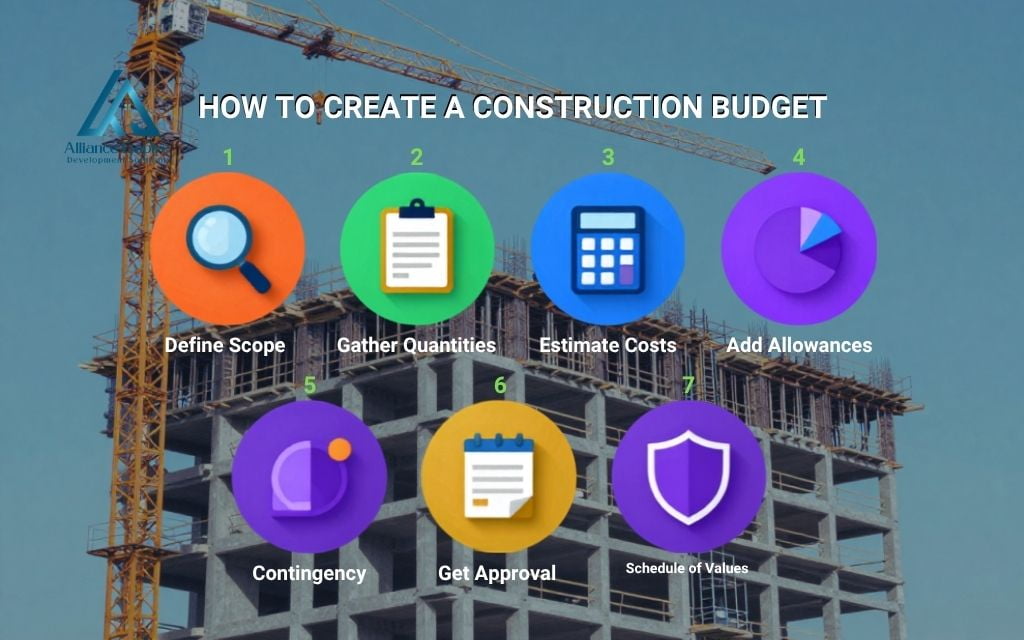
Knowing how to create a construction budget starts with a clear process. Follow these steps to build a construction budget plan that holds up once work begins.
- Define the project scope: Use a work breakdown structure to break the project into manageable tasks, and document the scope of work so everyone understands what is and is not included.
- Gather accurate quantities: Review architectural drawings and blueprints to perform a material takeoff and quantity takeoff, so you know exactly how much of each material and how much labor the project requires.
- Estimate costs by category: Price out labor, materials, subcontractor work, and equipment based on current market rates, supplier quotes, and historical project data where available.
- Add soft costs, allowances, overhead, and profit: Layer in design fees, permits, insurance, and placeholder allowances, then apply overhead and profit according to the contract type, whether that is fixed price, cost plus, or another structure.
- Build in contingency: Set aside a reserve sized to the project’s complexity and risk level.
- Get stakeholder approval: Review the full budget with the owner, lender, and other key stakeholders before work begins.
- Convert the budget into a schedule of values: Break the approved budget into line items that align with billing and payment draws throughout construction.
Construction budget management and control
Construction budget management is the ongoing work of tracking, monitoring, and adjusting costs against the original plan. Strong construction budget control depends on consistent habits throughout the project, not just a solid budget at the start.
- Track committed costs, actual costs, and cost to complete separately so you always know where you stand
- Use consistent cost codes so spending is easy to categorize and analyze
- Log every change order and get it approved before related work begins
- Review the budget on a regular schedule, weekly or monthly depending on project size
- Watch for budget variance and cost overrun percentage as early warning signs
- Update cost forecasts as material prices shift or conditions on site change
Budget in construction management is most effective when it is treated as a continuous process rather than a one time task completed before the project starts.
Learn more: Construction Quality Management
Common construction budgeting mistakes
Budgeting in construction comes with a few recurring pitfalls. Most of them are avoidable with the right habits.
- Forgetting permits and inspection fees: Permit costs vary by jurisdiction and project type, and skipping this step early often leads to budget surprises later.
- Underestimating site conditions: Soil quality, drainage, and slope can all add unexpected cost, especially on properties with conditions that were not assessed before budgeting began.
- Ignoring price escalation: Material costs can shift between the time a budget is set and when materials are purchased, so building in a buffer protects against this.
- Setting unrealistic allowances: Placeholder numbers that are too low to please an owner upfront tend to cause conflict and cost overruns down the line.
- Failing to track change orders: Every approved change needs to be logged and reflected in the budget immediately, or the budget quickly becomes inaccurate.
- Not updating the budget regularly: A budget that is not revisited as the project moves forward stops being a useful tool for decision making.
- Choosing the lowest bid without scrutiny: A bid that is significantly lower than others often signals missing scope or lower quality work, which can cost more to fix later.
Learn more: Construction Risk Management

Tools and software for construction budgeting
Many contractors and project managers rely on dedicated software to support construction budgeting and cost tracking. Below is a general overview of commonly used categories and examples among construction professionals in the United States.
| Tool category | Examples |
| Estimating and takeoff | PlanSwift, STACK, Bluebeam Revu |
| Budget and cost management | Procore, Sage 300 Construction and Real Estate, Buildertrend |
| Spreadsheet based templates | Excel, Google Sheets |
| Accounting integration | QuickBooks Contractor, Foundation Software, Viewpoint |

Conclusion
A reliable construction budget is what separates a project that finishes on time and on target from one that runs into financial trouble halfway through. Knowing the difference between hard costs and soft costs, sizing your contingency correctly, and staying committed to ongoing construction budget management are what keep a project financially sound from groundbreaking to closeout.
If you are planning a construction or roofing project in the Denver area and want help building a realistic, honest budget, Alliance EDS is here for you. With over 15 years of experience serving Colorado property owners, we provide clear estimates and straightforward guidance, without inflated numbers or pressure tactics. Call us at (720) 484-8181 to talk through your project!
Frequently asked questions (FAQs)
What is included in a construction budget?
A construction budget typically includes hard costs such as labor, materials, and equipment, soft costs such as permits, design fees, and insurance, an allowance for unfinished selections, overhead, contractor profit, and a contingency reserve for unexpected expenses.
What is the difference between a construction budget and a construction estimate?
An estimate is an early forecast of likely costs, often used during planning before details are finalized. A budget is the approved spending plan that guides the project once it is underway and is tracked against actual spending throughout construction.
How much contingency should be included in a construction budget?
Most residential projects use a contingency of around five to ten percent of the total budget. Renovations, commercial projects, or builds with higher risk factors often call for a larger reserve, sometimes up to twenty percent.
What are hard costs and soft costs in a construction budget?
Hard costs are expenses tied directly to the physical construction work, such as labor and materials. Soft costs are indirect or professional expenses, such as design fees, permits, financing, and insurance.
How often should a construction budget be reviewed?
A construction budget should be reviewed on a consistent schedule, typically weekly or monthly depending on the size and pace of the project, and updated any time a change order, price shift, or new bid affects the plan.