

Construction has always been one of America’s most essential industries, yet also one of its most stubbornly inefficient. Projects run over budget. Crews sit idle waiting on materials or approvals. Schedules slip week after week.
These problems are fixable. Improving efficiency in construction does not require a complete overhaul of your business overnight. It requires a clear understanding of what is slowing you down and the discipline to apply proven strategies consistently.
This guide breaks down exactly how to improve productivity in construction industry in 2026, from field-level tactics to company-wide frameworks. Contractors, project managers, superintendents, and business owners will find actionable strategies here to deliver better results on every job.
Understanding construction productivity today
Construction productivity measures how much work gets completed relative to the labor, time, materials, and equipment invested. When productivity is high, projects finish on schedule, budgets hold, and profit margins stay healthy. When it is low, the same crew working the same hours produces less output, and costs rise without a corresponding increase in progress.
By this measure, the construction industry has been falling behind for decades. According to the McKinsey Global Institute, construction labor productivity has averaged only 1% annual growth over the past twenty years, while manufacturing grew at 3.6% and the total economy at 2.8%. McKinsey estimates that closing this gap could unlock $1.6 trillion in additional annual value globally.
For U.S. contractors facing tight labor markets and rising material costs, the question of how to improve productivity on a construction site is no longer optional.

TOP 8 challenges that hurt construction productivity
Before learning how to improve construction productivity, it helps to understand exactly what is getting in the way. The following 8 bottlenecks are responsible for the majority of productivity losses across U.S. construction projects, and each one directly limits your ability to improve productivity in the construction industry at scale.
- Poor scheduling and look-ahead planning: Without a rolling look-ahead schedule, crews regularly arrive on-site to find nothing ready to work on. Idle time is one of the most expensive productivity killers in construction.
- Communication breakdowns between field and office: When field crews operate on outdated drawings or cannot reach a decision-maker, work stops or proceeds incorrectly. Poor communication costs the average construction company roughly 30 hours of lost labor per worker per month.
- Material and inventory mismanagement: Running out of materials mid-task brings work to a complete stop and sends ripple effects through the schedule. Proactive inventory management with defined reorder thresholds prevents these avoidable stoppages.
- Workforce shortages and undertrained labor: The ABC reported that the U.S. construction workforce gap has exceeded 500,000 workers. Firms that do not invest in training the workers they already have compounded the shortage with avoidable errors and slower output.
- Weather and unplanned downtime: A two-day storm can set a project back a full week when weather contingencies are not built into the schedule. Equipment failures, permit delays, and inspection holds add further unplanned downtime on top of that.
- Slow technology adoption: Construction ranks 21st out of 22 U.S. industries in digitization, and that gap shows up directly in project performance. Companies still using paper timesheets and manual RFI processes are competing at a serious structural disadvantage.
- Excessive rework and change-order delays: Rework accounts for 5% to 15% of total project costs on typical construction jobs. Every hour spent redoing work is an hour not spent moving the project forward.
- Unrealistic deadlines and poor workplace conditions: Timelines that do not reflect actual scope drive burnout, shortcuts, and turnover. Excessive overtime, inadequate rest, and inconsistent pay practices quietly drain labor productivity over time.
How to improve productivity in construction industry: 10+ proven ways
Build a realistic, living project schedule
The most effective scheduling approach combines 2 layers: a master schedule built on the Critical Path Method (CPM) and a rolling look-ahead schedule covering the next 3 to 6 weeks in detail.
The master schedule maps the full project from start to finish, identifies task dependencies, and keeps the critical path visible for the whole team. The key discipline is treating the schedule as a living document. When a delay occurs, it must be logged and every downstream task adjusted accordingly.
Construction scheduling software enables this automatically, recalculating the impact on all dependent activities in real time. A schedule the whole team believes in is far more effective than one built around wishful thinking.
Streamline field-to-office communication
Poor communication is the most consistent source of preventable loss when contractors work to improve construction productivity. Centralizing daily reports, RFIs, submittals, and change orders on a single platform eliminates the information silos that cause mistakes, rework, and idle time. A short daily huddle at the start of each shift, focused on the day ahead and existing obstacles, reinforces that discipline at the crew level.
Project leaders who actively solicit field feedback make better decisions and earn stronger crew commitment in return. If your team is currently using more than 2 or 3 communication channels across one active project, consolidation is overdue.

Adopt construction technology that pays for itself
Technology is no longer optional for any firm serious about improving construction productivity. Construction project management platforms such as Procore and Autodesk Construction Cloud connect the field and office, centralize documentation, and give every stakeholder real-time project data.
Building Information Modeling (BIM) takes this further by surfacing design conflicts before they reach the field. Drones, wearables, and AR tools continue to mature, and robotic equipment already in use at progressive job sites reduces physical fatigue and injury risk. Begin by identifying one manual, paper-based process your team performs daily and replacing it with a digital alternative.
Implement new technology the right way
Adopting new technology is essential to improve productivity in the construction industry, but each tool introduces risks that smart contractors plan for in advance. Cloud-based platforms for drawings, contracts, and financial data create cybersecurity exposure that should trigger a fresh review of both digital security practices and insurance coverage.
Professional liability also increases as design and construction become more interconnected through tools like BIM, making coverage review critical for design-build and design-assist delivery models.
Employee training is a non-negotiable prerequisite. A platform the field crew does not use consistently produces worse outcomes than no platform at all. Budget training time before going live, and document a contingency workflow for every critical process in case a system becomes unavailable on a high-stakes day.

Leverage data & analytics for smarter decisions
Most construction projects generate large volumes of data on every shift, yet most of it is never analyzed. Companies that change this practice gain a measurable competitive advantage in improving construction productivity.
Key metrics worth tracking on every project include:
- Labor productivity rate: units installed per labor hour, compared against the estimate
- Schedule Performance Index (SPI): earned schedule value divided by planned value
- Cost Performance Index (CPI): earned cost value divided by actual cost
- Rework percentage: rework hours as a share of total project labor hours
- Equipment utilization rate: hours of productive equipment use divided by hours available
Analyzing this data across multiple projects identifies patterns. If rework spikes during a specific phase, that is a training or supervision issue worth addressing. If equipment utilization is low on certain project types, there may be a scheduling or procurement problem. Data makes these conversations specific and actionable.
Train, retain & recognize your workforce
The construction labor shortage is real, widely documented, and not going away soon. But workforce scarcity makes investing in the people you already have more important, not less.
Effective workforce development includes structured skill ladders from apprentice to journeyman to foreman, regular safety training, and trade-specific upskilling as new technologies enter the field.
Partnerships with apprenticeship programs through the AGC and ABC offer access to trained workers while building the industry’s broader pipeline.

Boost morale through recognition & workplace flexibility
Productivity in the construction industry has a human dimension that is often overlooked in operational discussions. Research from the University of Warwick found that happy workers are approximately 12% more productive than their disengaged counterparts.
Recognition does not require a large budget. Acknowledging a crew that hit a milestone on time, calling out a worker by name for solving a problem, or simply communicating that their work mattered builds the kind of engagement that shows up in daily output.
Formal incentive programs, fair pay between full-time and contract workers, and adequate rest between demanding stretches all reduce burnout, lower turnover, and keep crews performing at their best.
Apply lean construction principles
Lean construction is one of the most thoroughly validated frameworks for improving construction productivity, and it remains underutilized at most firms. Developed from lean manufacturing principles and codified by the Lean Construction Institute, the framework focuses on maximizing value delivery while systematically eliminating waste through 3 core practices:
- Collaborative pull planning brings all stakeholders, including owner, GC, subs, and suppliers, into the scheduling process together, working backward from the project’s end date to build a timeline everyone believes is achievable.
- Just-in-Time (JIT) delivery aligns materials, labor, and equipment with the moment they are actually needed, reducing site clutter, theft risk, and excess inventory costs.
- Waste reduction targets overproduction, waiting, unnecessary transportation, excess inventory, unnecessary motion, defects, and underutilized talent, each of which has direct construction equivalents.
Improve materials and equipment management
Materials and equipment are the physical inputs that make construction work happen. When they are managed poorly, productivity stops. When they are managed well, crews work at full capacity with minimal interruption.
Effective materials management starts with proactive inventory auditing, reviewing stock levels against the upcoming work plan weekly and defining reorder thresholds for every key material that factors in supplier lead times.
For high-value tools and equipment, barcode or RFID tracking reduces time spent searching and reduces loss and theft. Equipment utilization tracking identifies whether assets are actively being used or sitting idle on-site, consuming cost without generating value.
Standardize processes & build a design library
One of the simplest and most underused productivity tools in construction is standardization. A McKinsey Global Institute survey found that only 50% of firms maintained a standard design library, covering reusable specifications, drawings, and details.
For firms that maintain one, every new project incorporating standard elements starts with a head start rather than from scratch. Standard operating procedures (SOPs) for common tasks, from excavation safety checks to roof installation sequences, capture the knowledge of your best workers and make it repeatable by everyone.
When every project uses the same system for daily reporting, RFIs, and change orders, the cognitive load on every manager is significantly reduced. Template-based estimating and scheduling extends this principle to pre-construction, reducing preparation time and improving accuracy with each iteration.
Embrace prefabrication and modular construction
Prefabrication, manufacturing building components off-site in a controlled factory environment and assembling them on-site, represents one of the highest-upside productivity opportunities in construction today.
The productivity gains come from parallel production, where building components are manufactured off-site while site preparation happens simultaneously. Factory-built components benefit from controlled conditions, standardized tooling, and specialized labor, producing higher quality with less variability.
In roofing and framing applications, prefabricated roof truss systems can reduce framing time by several days on a residential or light commercial project.
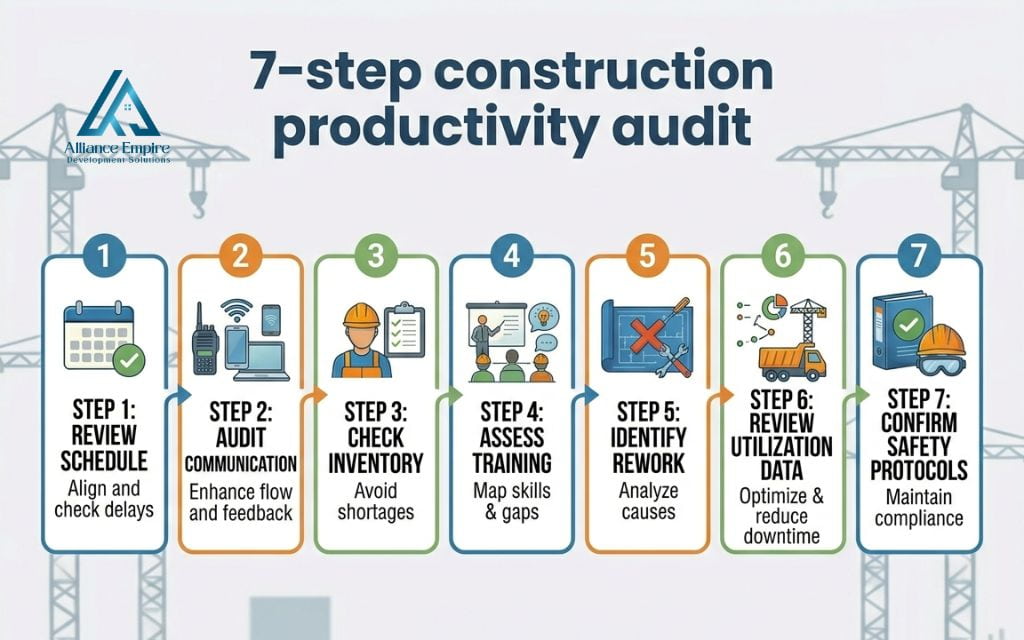
A 7-step construction productivity audit (practical checklist)
Knowing how to ensure construction site productivity starts with being able to see exactly where it is breaking down. Use the following checklist on any active project to identify your highest-priority gaps.
Step 1: Review the master schedule
Is a current look-ahead schedule in place for the next 3 to 6 weeks? Is it up to date and has it been reviewed with the crew this week? If not, this is the most urgent fix.
Step 2: Audit field-to-office communication channels
Count the number of different platforms, apps, and communication methods currently in use across the project. If the number exceeds 2 or 3, consolidation is overdue. Identify which platform most of the team is not using consistently and address the adoption gap.
Step 3: Check inventory levels against upcoming work
Review your materials stock against the next 14 days of planned work. Identify any shortfalls and confirm that orders are placed with enough lead time to prevent a stoppage. Note any materials that are overstocked and taking up site space unnecessarily.
Step 4: Map training gaps for crew members
Walk through your current crew roster and identify any workers performing tasks they have not been formally trained on. Identify any new tools, equipment, or software in use without proper training completed. Prioritize the highest-risk gaps for immediate attention.
Step 5: Identify the top 3 sources of rework in the last 90 days
Review recent daily reports, inspection records, and project manager notes. What work has had to be redone, and why? Categorize by cause: miscommunication, design conflict, material defect, or workmanship. Each category requires a different corrective action.
Step 6: Review equipment utilization data
For every piece of major equipment on-site, calculate the ratio of hours actively used to hours available. Any piece of equipment with a utilization rate below 60% warrants investigation. Is it waiting on task readiness? Is it the wrong equipment for the job?
Step 7: Confirm safety protocols are documented and current
Review your active safety plan against the current project phase. Confirm that all required OSHA documentation is in order, PPE is available and in good condition, and toolbox talk records are current. A project falling behind on safety documentation is often falling behind in other areas too.
Common mistakes to avoid when improving productivity
Every contractor who sets out to improve productivity in the construction industry will encounter the same pitfalls. Understanding how to improve construction productivity is only half the equation; avoiding the patterns below is equally important.
- Pushing for more hours instead of better systems: Overtime is one of the most expensive and least effective responses to a productivity problem. Fatigued workers make more mistakes, mistakes generate rework, and rework consumes the extra hours gained. If a project is behind, the first question should be what system is failing, not how many extra hours the crew can work.
- Buying software without a rollout plan: Construction management software only improves productivity if people use it correctly and consistently. Many technology investments fail not because the software is inadequate but because implementation was rushed and training was skipped.
- Cutting safety corners to recover schedule: An OSHA violation, a recordable incident, or a lost-time injury creates delays, costs, and liability exposures that dwarf any schedule benefit gained. This is one of the most counterproductive decisions a project leader can make.
- Ignoring subcontractor coordination: General contractors who manage their own crews efficiently but fail to actively coordinate subcontractors create bottlenecks at every trade handoff. Treat subcontractor coordination as a first-tier project management responsibility, not a secondary concern.
- Setting unrealistic deadlines without a plan to support them: An aggressive deadline without the labor, materials, and equipment to support it is not ambition; it is a setup for failure. Build timelines from the bottom up, based on what the work actually requires.
Conclusion
Improving construction productivity is not a single decision. It is a discipline built through better planning, clearer communication, smarter use of technology, and continued investment in people.
The strategies in this guide address every major dimension of how to improve productivity in construction industry, from scheduling and field communication to lean principles, prefabrication, data analytics, and workforce development.
The construction industry’s productivity gap is real, but it is not inevitable. Applied consistently, these principles compound into measurable advantages in project margins, client satisfaction, and team retention. Start with the 7-step audit, address the bottleneck costing you the most right now, and build from there.
Ready to work with a Denver construction partner you can trust?
Alliance EDS is a locally owned Denver company with over 15 years of experience delivering dependable construction solutions across Colorado. Honest assessments, clear communication, and quality execution, not sales pressure. Contact our team today for a free inspection.
Frequently asked questions (FAQs)
What is the biggest factor affecting construction productivity?
Poor scheduling and planning is consistently the leading driver of productivity loss in the construction industry. When crews arrive on-site with nothing ready to work on because materials have not arrived or a decision has not been made, those hours cannot be recovered. Look-ahead planning and active schedule management address this root cause more directly than any other single intervention.
How do you measure productivity on a construction site?
The most practical starting point is tracking labor productivity rate, which measures units installed per labor hour against the project estimate. The Schedule Performance Index (SPI), Cost Performance Index (CPI), rework percentage, and equipment utilization rate round out a complete framework for measuring and improving construction productivity at the field level.
What are the 5 key performance indicators in construction?
The five KPIs most directly tied to improving construction productivity are labor productivity rate, Schedule Performance Index (SPI), Cost Performance Index (CPI), rework percentage, and equipment utilization rate. Together, they give project managers a clear view of where time and money are being lost on a construction site.
What are the 4 pillars of KPI?
The four pillars are clarity (each metric is consistently defined), relevance (each KPI ties to a meaningful project outcome), timeliness (data is reviewed frequently enough to drive action), and accountability (each KPI is owned by a specific person or team). Applying these pillars to productivity in the construction industry ensures that tracking numbers leads to real operational improvement.
What technology improves construction productivity the most?
Construction project management software delivers the broadest documented impact, improving project predictability by approximately 20% and reducing costs by around 15%. BIM offers the highest return on large, complex projects, while field-level time-tracking and daily reporting apps that replace paper-based processes deliver fast, measurable gains in how to improve productivity on a construction site.
How can small construction companies improve productivity without large software investments?
Start with process standardization. Documenting common workflows as standard operating procedures, building a basic scheduling template, and running a weekly look-ahead review using a simple spreadsheet generates meaningful improvements in construction productivity at no software cost, while building the discipline that makes any future technology investment more effective.
What is the average labor productivity growth rate in the U.S. construction industry?
According to McKinsey Global Institute and Bureau of Labor Statistics data, U.S. construction labor productivity has averaged approximately 1% annual growth over the past two decades, compared to 2.8% for the total economy and 3.6% for manufacturing. This persistent gap represents both a challenge and a significant opportunity for contractors committed to improving their operational practices.