


If you’ve ever submitted a construction pay application and been asked for a G702 or G703, you’ve already encountered AIA billing. It’s the standardized progress billing method used across the US construction industry to request payment for work completed during a project.
AIA billing helps owners, contractors, lenders, and accountants track project progress and payments in a consistent, transparent way. Whether you’re a general contractor preparing your pay application or an owner reviewing one, understanding this format makes the entire payment process smoother.
What is AIA billing?
AIA billing is a standardized construction payment application process developed by the American Institute of Architects (AIA). It gives contractors a uniform way to document work completed and request progress payments throughout the life of a project.
An AIA pay application is used to document:
- Work completed during the billing period
- Payment requests based on percentage of completion
- Retainage withheld by the owner
- Approved change orders affecting the contract sum
- The remaining contract balance still to be billed
Because the AIA billing format is widely recognized, it’s often required by owners, lenders, and architects on commercial and institutional projects.
Learn more: What is a DPR in construction

Why is AIA billing used in construction?
AIA billing is commonly used in construction because it provides a standardized way to request and review progress payments on projects that are billed over time. Instead of billing only at project completion, contractors can document completed work, stored materials, retainage, approved change orders, previous payments, and the current amount due.
- Creates a standardized payment process: AIA billing gives owners, architects, contractors, and subcontractors a consistent format for reviewing pay applications, which can help speed up approval.
- Improves transparency for owners and lenders: AIA-style billing documents show how much work has been completed, how much has already been paid, what retainage is being withheld, and what balance remains. When a project is lender-financed, this documentation can support the draw review process.
- Tracks project progress against the schedule of values: Each billing cycle updates progress by line item, making it easier to compare billed work against the project’s schedule of values and identify potential cost or progress issues.
- Helps reduce payment disputes: Because AIA billing creates a clear record of completed work, retainage, change orders, and prior payments, it can reduce confusion over what has been earned and what is currently owed.
- Supports construction financing and draw requirements: Many banks, owners, and institutional lenders require or prefer AIA-format pay applications before approving construction draws or progress payments.
Terms related to the AIA billing process
Understanding a few key construction accounting terms makes AIA billing much easier to follow.
Retainage
Retainage is a percentage of earned payments that the owner temporarily withholds under the contract. It is often held until substantial completion, final completion, or another contract-defined milestone. Retainage gives the owner financial protection and encourages the contractor to complete the work according to the contract requirements.
For example, if a contractor has earned $100,000 in the current billing period and the contract requires 10% retainage:
- Amount earned before retainage = $100,000
- Retainage withheld = $10,000
- Amount due before other adjustments = $90,000
Schedule of Values (SOV)
A schedule of values is a detailed breakdown of the contract sum into individual work items, phases, or cost categories. It serves as the foundation for the G703 Continuation Sheet because each line item is billed based on the value of work completed and, when allowed, materials stored.
Typical schedule of values categories include:
- Sitework
- Concrete
- Structural steel
- Framing
- Electrical
- Plumbing
- HVAC
- Finishes
Stored materials
Stored materials are materials purchased or procured for the project but not yet installed. Contractors may request payment for stored materials when the contract allows it and when the materials are properly documented, delivered, stored, insured, and approved for billing.
Common examples include:
- Structural steel
- Roofing materials
- HVAC equipment
- Electrical switchgear
- Custom fabrication components
Change orders
A change order is a formal modification to the original construction contract that changes the project scope, schedule, contract sum, or other contract terms. Approved change orders increase or decrease the contract sum and should be reflected in future pay applications and billing calculations.
Common causes include:
- Owner-requested changes
- Design revisions
- Unforeseen site conditions
- Material substitutions
Applications for payment (Pay applications)
A pay application is a formal request for payment submitted by the contractor during the project. In AIA billing, the G702 and G703 forms are commonly used together as the standard application for payment packages.
A pay application summarizes completed work and calculates the amount currently due. Information typically included:
- Original contract sum
- Approved change orders
- Work completed to date
- Retainage withheld
- Previous payments received
- Current payment request
AIA contract documents: G702 and G703
The two core documents in AIA billing are the G702 and G703. Together, they form the complete AIA pay app that contractors submit each billing cycle.
What is AIA form G702?
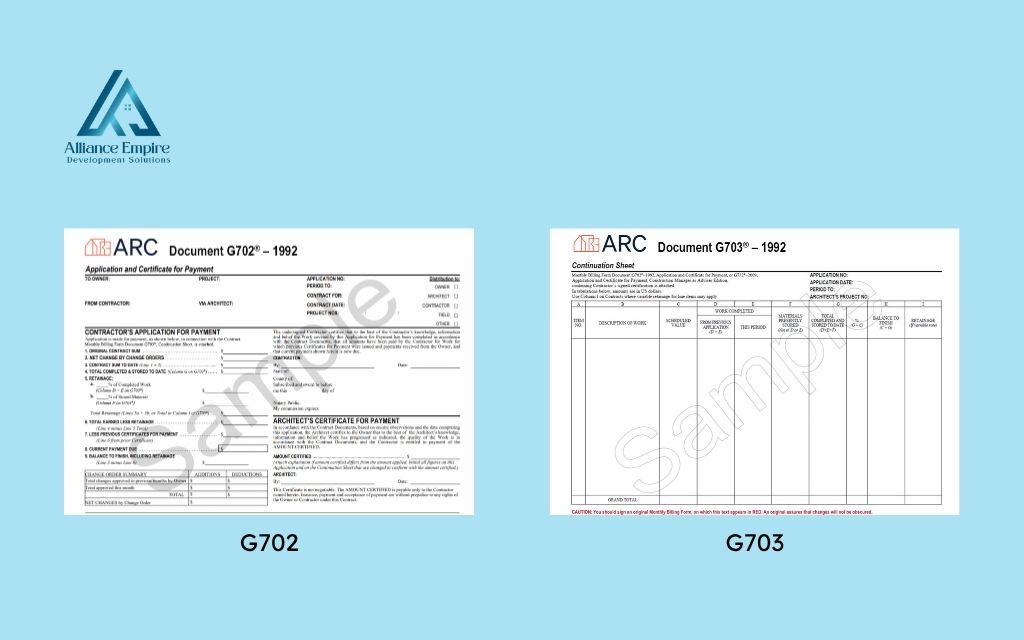
The G702 is the Application and Certificate for Payment. It serves as the summary page of the pay application and is used by the contractor to request payment. In the traditional AIA process, the architect reviews the application and certifies the amount due.
The G702 summarizes:
- Original contract sum
- Approved change orders
- Contract sum to date
- Total completed and stored to date
- Retainage withheld
- Previous certificates for payment
- Current payment due
- Balance remaining on the contract
What is AIA form G703?
The G703 is the Continuation Sheet that supports the G702. While the G702 provides the summary, the G703 shows the detail behind the numbers.
The G703 provides:
- A detailed breakdown of project costs
- The schedule of values
- Work completed from previous applications
- Work completed during the current billing period
- Materials presently stored, when applicable
- Total completed and stored to date
- Percentage completed for each line item
- Balance remaining for each line item
- Retainage, when applicable
In short, the G703 supports every calculation shown on the G702, and reviewers typically check the G703 first to verify line-item progress.
Supporting documentation for AIA billing
In addition to forms G702 and G703, owners, architects, lenders, or general contractors may require supporting documentation to verify the amounts being billed. Requirements vary by project, contract, lender, and jurisdiction.
- Change order log. Includes approved change orders, pending change orders, and contract value adjustments.
- Insurance certificates. Includes general liability insurance, workers’ compensation coverage, and builder’s risk insurance when applicable.
- Stored material invoices. Includes vendor invoices, purchase orders, proof of payment, and material inventory records.
- Lien waivers and releases. Includes conditional lien waivers, unconditional lien waivers, and subcontractor and supplier releases.
- Progress photos and delivery receipts. Includes jobsite progress photographs, material delivery tickets, and shipping receipts.
- Detailed cost and activity reports. Includes labor hour reports, equipment usage logs, cost breakdown reports, and activity-based project summaries.
How the AIA billing process works
Once the contract is signed and the schedule of values is approved, AIA progress billing follows a predictable cycle that repeats each billing period, usually monthly.
Here’s what happens at each stage.
Step 1: Create the Schedule of Values
The schedule of values (SOV) is the foundation of every future pay application, so it deserves careful attention at the start of the project.
The contractor breaks the total contract price into individual line items that represent each major component of work, such as sitework, concrete, framing, mechanical, electrical, and finishes. Each line item is assigned a dollar value, and the sum of all line items must equal the original contract amount.
The SOV is typically submitted to the architect and owner for review before the first pay application. Once approved, it becomes the structure used for billing throughout the project.
A well-organized SOV with appropriately sized line items makes future progress measurement easier and reduces back-and-forth during reviews.
Step 2: Track project progress
During each billing period, the contractor measures how much work has been completed for each line item on the SOV.
Progress is generally tracked through daily field reports, superintendent updates, photographs, and site walks with the owner or architect. For some line items, progress is measured in physical units installed, such as cubic yards of concrete poured or square feet of drywall hung.
For others, it is estimated as a percentage of completion based on labor and materials in place.
Step 3: Update the G703 continuation sheet
With progress measured, the contractor updates the G703 to reflect the current billing period.
For each line item, the G703 records the scheduled value, the work completed from previous applications, the work completed during the current period, and any materials presently stored on or off site. The form then calculates the total completed and stored to date, the percentage complete, and the balance to finish.
Stored materials are listed separately from installed work so that reviewers can verify those materials are properly secured, insured, and documented with vendor invoices.
Step 4: Complete the G702 summary
Once the G703 is updated, the totals flow up to the G702, which serves as the cover page and summary of the pay application.
The G702 shows the original contract sum, the net change by change orders, the revised contract sum, the total completed and stored to date, retainage withheld, the total earned less retainage, previous payments received, and the current payment due.
The contractor signs and notarizes the G702 to certify that the amounts requested accurately reflect work completed and that the contractor has paid prior obligations related to previous payments.
Step 5: Submit the pay application
The complete AIA requisition package is then submitted to the project’s reviewing parties. Depending on the project structure, this may include the owner, architect, construction manager, and lender.
Most projects have a specific submission date each month, and many require supporting documentation alongside the G702 and G703, such as updated lien waivers, change order logs, stored material invoices, insurance certificates, and progress photos.
Step 6: Review and architect certification
The architect reviews the pay application against observed progress on site and the documentation provided.
If the architect finds the application accurate, they certify it by signing the G702 and indicating the amount certified for payment. The architect can also certify a different amount than what the contractor requested if they believe the percentage complete on certain line items is overstated, and they will note the reason for any adjustment.
The owner then conducts a final review before authorizing payment. On lender-financed projects, the lender may also review the certified application before releasing funds from the construction loan.
Step 7: Payment processing
Most construction contracts specify a payment window, often within 30 days of certification, though terms vary by project and state prompt payment laws. The owner pays the certified amount, the contractor records the payment, and the cycle restarts for the next billing period.
Throughout the project, retainage continues to accumulate on each application and is released in 2 stages: a portion at substantial completion and the remainder at final completion, once punch list work, lien waivers, and closeout documents are accepted.
Learn more: What is construction quality management

Common AIA billing mistakes
Even experienced contractors run into avoidable issues with AIA billing. Watch for these common problems.
- Inaccurate schedule of values: A poorly structured SOV with vague line items makes every future pay application harder to justify and review.
- Incorrect percentage completion calculations: Overstating progress can trigger rejections, delay payment, and damage trust with the owner or architect.
- Missing change orders: Performing extra work without an approved change order often leads to billing disputes and unpaid labor.
- Improper retainage calculations: Applying retainage to the wrong base amount, especially after change orders, is a frequent source of errors.
- Incomplete documentation: Missing lien waivers, insurance certificates, or stored material invoices can stall the entire payment cycle.
- Delayed submission of pay applications: Late submissions push payment further out and can strain cash flow on the project.
Conclusion
AIA billing provides a standardized way to manage construction payments, track project progress, and improve transparency among contractors, owners, architects, and lenders. Once you understand the roles of G702 and G703, along with retainage, schedules of values, and change orders, the process becomes far less intimidating.
Whether you’re submitting your first AIA invoice or refining an existing billing workflow, accurate documentation and clean line-item tracking are what keep payments moving on time.
Need help managing construction documentation, pay applications, or project administration? Contact Alliance EDS to discuss your project today.
Frequently asked questions (FAQs)
What is the difference between AIA and progress billing?
Progress billing is the broader concept of billing for work as it is completed over time. AIA billing is a specific, standardized format of progress billing that uses AIA forms G702 and G703 and is widely recognized in US commercial construction.
What is the AIA billing format?
The AIA billing format is a structured pay application that combines a summary sheet (G702) with a detailed continuation sheet (G703). It shows the original contract value, completed work, retainage, change orders, previous payments, and the current amount due.
What is AIA payment?
An AIA payment is a progress payment made to a contractor based on an approved AIA pay application. The amount reflects the value of work completed during the billing period, minus retainage and previous payments.
What is an AIA invoice?
An AIA invoice is another name for an AIA pay application. Unlike a standard invoice, it follows the AIA format and includes a schedule of values, percentage of completion for each line item, retainage, and architect certification.
How to pay AIA bills?
Owners typically pay AIA bills after the architect certifies the pay application and the owner reviews the supporting documentation. Payment is then issued according to the payment terms in the construction contract, often within 30 days of certification.
What is the difference between G702 and G703?
The G702 is the one-page summary and certificate for payment, while the G703 is the continuation sheet that breaks the contract down into line items and shows the percentage of completion for each. The G702 relies entirely on totals calculated from the G703.
Is AIA billing required on every project?
No. AIA billing is most common on commercial, institutional, and larger residential projects, especially those involving architects or lenders. Smaller projects may use simpler invoicing methods, though many contractors still prefer the AIA format for consistenc