
Picture a crew arriving on site, ready to work, only to discover that the drawings are incomplete, the specialty materials have not been delivered, access to the work area is blocked, and the permits are still pending. This scenario plays out on capital construction projects every day, and the cost in wasted labor, rescheduling, and rework adds up fast. Understanding what is AWP in construction starts with recognizing the planning problem it was designed to solve.
In construction, AWP most commonly stands for Advanced Work Packaging, a construction-driven planning methodology that organizes complex projects into clearly defined, executable packages so that field crews receive work that is ready to perform. This guide explains the full meaning of AWP in construction, the work package hierarchy, key terminology, how AWP compares to traditional planning, and when the approach makes sense for your project. It also briefly clarifies the second meaning of AWP, Aerial Work Platform, for readers in a safety or equipment context.
What does AWP stand for in construction?
The acronym AWP carries two distinct meanings in the construction industry, and knowing which applies depends entirely on context.
Advanced Work Packaging (AWP) is a planned, executable process that encompasses the work on an engineering, procurement, and construction project, from initial planning through detailed design and construction execution. The Construction Industry Institute (CII) classifies AWP as a best practice for capital project delivery. The AWP Institute defines it as a construction-driven planning and collaboration system sharply focused on creating a constraint-free work environment in the field.
Aerial Work Platform (AWP) refers to vehicle-mounted or self-propelled equipment such as boom lifts, scissor lifts, and mobile elevating work platforms (MEWPs) used to elevate workers to height. OSHA regulates these devices under its aerial lift standards, covering operator training, fall protection, and pre-use inspection requirements.
A practical rule: if the discussion involves project planning, scheduling, EPC workflows, or field productivity, AWP refers to Advanced Work Packaging. If it involves safety, equipment certification, or fall protection, AWP refers to an Aerial Work Platform. The rest of this article covers Advanced Work Packaging.
Learn more: How to plan a construction project that stays on budget and finishes on time
What is Advanced Work Packaging (AWP)?
Advanced Work Packaging is a process framework for construction projects that inverts the traditional planning sequence. In conventional practice, engineering teams produce design deliverables according to their own internal logic, and construction teams adapt to whatever packages they receive, often creating field workarounds when the information does not translate well to site conditions.
AWP construction planning changes this dynamic. The Path of Construction, meaning the optimal physical sequence in which the facility will be built, drives engineering deliverables and procurement activities from day one. Work is broken into progressively smaller packages aligned with how field crews will actually execute. The result is that the right drawings, materials, tools, access, and permits are in place when each package reaches the workface.
Core principles of advanced work packaging:
- Construction sequencing drives engineering and procurement, not the reverse
- Engineering deliverables, material procurement, and field execution are aligned to a single sequence
- Work is released to crews only when all constraints are cleared: drawings complete, materials confirmed, access open, permits in hand
Learn more: Benchmark in construction

Why AWP matters: The problem it solves
The root cause of most construction delays is planning misalignment: field crews are released to work before the conditions for productive execution are in place. Drawings arrive late. Materials sit unallocated in laydown yards. Access routes are blocked by concurrent trades. Each constraint forces crews off scope and generates non-productive time that compounds across the project.
AWP project management addresses this at the source by synchronizing engineering, procurement, and construction around a single reference point: what the field needs, when it needs it, and in what sequence. Procurement timing is tied directly to work package need dates, which removes material-related delays before crews encounter them.
When implemented consistently, AWP delivers measurable benefits:
- Higher field productivity: Peer-reviewed comparative research on AWP and Workface Planning shows significantly higher and more predictable direct work rates on projects using both methods
- Better schedule and cost predictability: Constraint removal upstream reduces the scope for unplanned delays mid-execution
- Reduced rework and shorter punch lists: Crews working from complete, approved packages make fewer errors and generate less corrective work at closeout
- Improved safety: IWPs are designed with safety built into the work sequence, not added as a final review layer
- Better site organization and team morale: Clear scope ownership and staged material delivery reduce confusion between trades and foster more collaborative project culture
The AWP work package hierarchy explained
Construction work packaging organizes a project into a structured hierarchy of discrete scope deliverables. Each level feeds the next, moving from project-wide geographic planning down to the field-ready advanced work package a single crew executes over one to two weeks. The table below defines each package type, what it contains, and which team owns it.
| Acronym | Full Name | What It Contains | Owned By |
| CWP | Construction Work Package | Scope, drawings, and information needed to build a defined portion of the project | Construction team |
| EWP | Engineering Work Package | Design deliverables (drawings, specs, models) aligned to a specific CWP | Engineering team |
| PWP | Procurement Work Package | Materials and equipment procurement timing tied to CWP need dates | Procurement team |
| IWP | Installation Work Package | A constraint-free, field-ready advanced work package a crew can complete in one to two weeks | Workface planner |
| SWP | System Work Package | Scope tied to system commissioning and turnover sequencing | Commissioning / startup team |
Key AWP terms every construction professional should know
AWP introduces a consistent set of terms that appear across industrial construction planning literature, software platforms, and CII publications. Knowing these definitions helps project teams communicate clearly and evaluate implementation maturity.
- Path of Construction (PoC): The optimal sequence of activities for physically delivering the project scope; defined early and refined as the project progresses
- Construction Work Area (CWA): A geographic zone of the project, derived from the PoC, used to organize CWPs and provide spatial context for sequencing
- Workface Planning (WFP): The detailed planning process that breaks CWPs into IWPs ready for field execution; the bridge between project planning and jobsite crew performance
- Constraint-free work: A condition in which all materials, drawings, permits, tools, access, and labor needed to execute a package are confirmed before the IWP is released to the field
- AWP Champion: The senior project leader responsible for driving AWP adoption across the full project team, including owner, EPC, and contractor organizations
- Information Manager: Coordinates data flow and deliverable handoffs between engineering, procurement, and construction to keep packages on schedule
- Workface Planner: Creates, sequences, and approves IWPs; the operational link between AWP project management planning and field crew execution
How AWP works: The implementation sequence
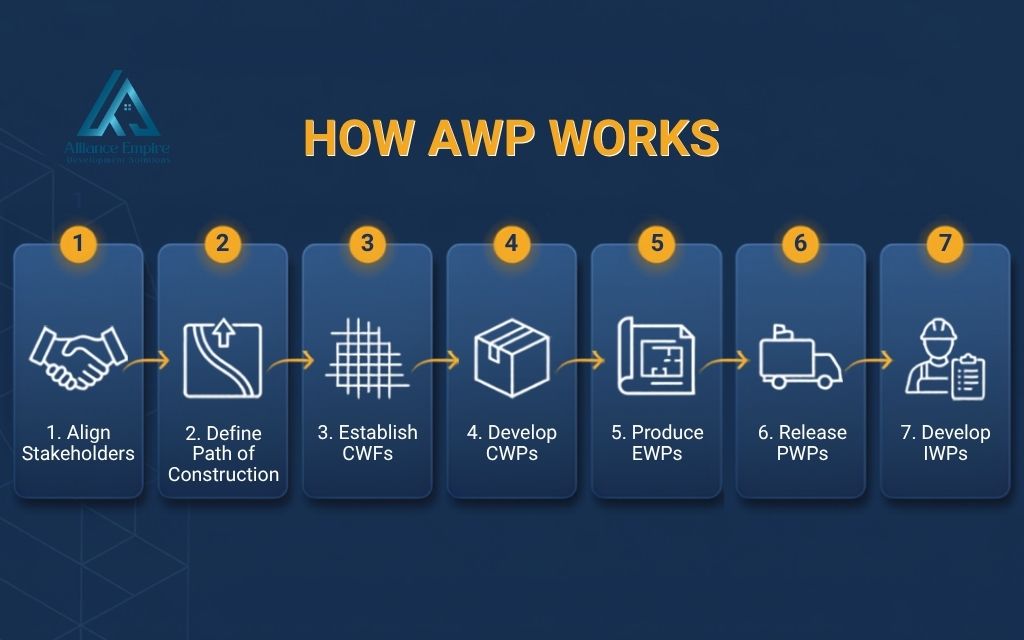
Most AWP implementations follow a consistent sequence designed to remove constraints upstream rather than discover them reactively on the jobsite:
- Align all stakeholders from day one: The owner, EPC contractor, procurement team, and construction team all commit to AWP before detailed engineering begins; late adoption sharply limits the methodology’s value.
- Define the Path of Construction: The team establishes the optimal physical sequence for building the project, factoring in site logistics, trade coordination, material lead times, and commissioning requirements.
- Establish Construction Work Areas (CWAs): The project is divided into geographic zones aligned with the PoC, providing the spatial structure for all downstream construction work packaging.
- Develop Construction Work Packages (CWPs): Discrete scope deliverables are defined for each CWA, describing what needs to be built and when, relative to the overall sequence.
- Engineering produces aligned EWPs: Design deliverables are structured and sequenced to support each CWP on the schedule that construction requires
- Procurement releases material packages (PWPs): Materials and equipment are ordered and tracked against the need date established by each CWP, with full supply chain visibility from requisition through issuance to the installer.
- Workface planners develop and approve IWPs: Field-ready, constraint-checked advanced work packages are assembled, reviewed, and released to crews, typically representing one to two weeks of work for a specific trade in a defined area.
- Execute, track, and refine: Crews work from approved IWPs; the Path of Construction is updated as conditions change, assumptions are corrected, or new information becomes available.
Who uses AWP and on what types of projects?
AWP in construction is most widely adopted in sectors where multi-discipline coordination is complex, material lead times are long, and schedule or cost overruns carry significant financial consequences.
Industries where AWP and industrial construction planning are most common:
- Oil, gas, and petrochemical plant construction
- Power generation, utilities, and renewable energy facilities
- Mining and minerals processing plants
- Heavy industrial and large manufacturing facilities
- Major infrastructure, transportation, and civil engineering projects
- Pharmaceutical, chemical, and data center construction
Mid-sized commercial and industrial contractors can also benefit from AWP principles, specifically defining a Path of Construction, packaging work for the field, and removing constraints upstream, without deploying a full enterprise work packaging system.
Learn more: 3 Phases of Construction: The Construction Phase Explained

AWP versus traditional construction planning
The table below compares how traditional project planning and advanced work packaging handle the same dimensions of project delivery, making clear where the two approaches diverge and why AWP produces more predictable outcomes on complex projects.
| Element | Traditional planning | AWP |
| Planning driver | Engineering schedule | Construction sequencing (Path of Construction) |
| When construction joins | After design is mostly complete | At project kickoff, alongside engineering and procurement |
| Work breakdown | WBS, often disconnected from field reality | CWAs, CWPs, and IWPs aligned to how crews actually build |
| Materials timing | Procured by category or bulk order | Procured to match each work package need date |
| Constraints | Discovered in the field, often too late to prevent delay | Identified and removed upstream before work is released |
| Field productivity | Variable, frequently eroded by waiting, rework, and confusion | More predictable, with higher direct work rates on tools |
Common challenges when implementing AWP
AWP delivers its strongest results when adopted fully and from project inception. In practice, several recurring obstacles limit implementation effectiveness:
- Late adoption: Starting AWP after engineering is substantially complete prevents the Path of Construction from influencing design sequencing, which is where most of the methodology’s value is generated
- Siloed teams: Engineering, procurement, and construction must collaborate from kickoff; AWP fails when any discipline treats it as someone else’s responsibility
- Software-first thinking: Deploying a work packaging platform without changing underlying planning processes produces data without discipline; the methodology must lead the technology
- Paper-based and high-latency workflows: Relying on printed IWPs and manual status updates eliminates the real-time constraint visibility that makes AWP effective in fast-moving field conditions
- Proprietary data standards and closed system architectures: Legacy AWP platforms often store data in formats that cannot be shared across systems, forcing teams to recreate information and reinforcing the silos AWP is designed to eliminate
- Cost and scalability barriers on smaller projects: Traditional enterprise AWP applications were built for mega-projects; smaller teams need lighter-weight approaches that deliver the planning discipline without the overhead of a full enterprise deployment.

Conclusion
Understanding what is AWP in construction comes down to recognizing what the methodology solves. Advanced Work Packaging is a construction-driven planning framework that breaks complex projects into constraint-free packages aligned to a Path of Construction. As a CII best practice, AWP in construction improves productivity, schedule predictability, and cross-functional alignment across engineering, procurement, and field execution. AWP also stands for Aerial Work Platform in safety and equipment contexts.
If you are planning a construction or roofing project in the Denver area and want a team that prioritizes disciplined planning and transparent execution, Alliance EDS is ready to help. Call (720) 484-8181 to schedule a virtual estimate or on-site assessment today.
Frequently asked questions (FAQs)
What does AWP stand for in construction?
AWP most commonly stands for Advanced Work Packaging, a construction-driven planning methodology that organizes complex projects into executable packages aligned to a Path of Construction. In safety and equipment contexts, AWP refers to Aerial Work Platform, covering equipment such as boom lifts and scissor lifts.
What is the difference between a CWP and an IWP?
A Construction Work Package (CWP) defines the full scope of work for a geographic area of the project. An Installation Work Package (IWP) is a field-ready subset of a CWP containing only constraint-free work a single crew can complete in one to two weeks.
Is Advanced Work Packaging only for large projects?
AWP was developed for large capital and industrial projects, but its core principles apply at any scale. Smaller teams can adopt AWP planning discipline selectively without deploying a full enterprise work packaging system.
What software is used for Advanced Work Packaging?
Advanced work packaging software typically handles supply chain tracking, work package creation and approval, constraint management, and Path of Construction visualization. Options range from dedicated AWP platforms to modules within broader project controls suites.
How does AWP improve field productivity?
AWP ensures crews receive constraint-free work, meaning drawings, materials, permits, and site access are all confirmed before a package is released. This eliminates the waiting time and rework that occur when crews arrive at a scope with missing prerequisites.