
Closing out a profitable year on paper does not guarantee a construction company can still make payroll in March. That gap between reported profit and available cash is exactly the problem a construction cash flow forecast is built to solve.
Unlike a budget, which sets spending expectations, this kind of forecast tracks the actual timing of cash moving in and out of the business, often the difference between a project that funds itself and one that quietly drains working capital. This article covers how to build one, the methods behind it, common risks that throw forecasts off track, and how software and business intelligence tools improve accuracy.
What is a construction cash flow forecast
A construction cash flow forecast is a projection of the cash a company or project expects to receive and pay out over a defined period, typically broken down by week or month. It answers a narrower and more urgent question than a budget does: will there be enough cash on hand to cover payroll, materials, subcontractor payments, and other obligations as they come due.
Forecasting in construction differs from forecasting in most other industries because of how the work gets paid. Contracts are billed against milestones or percentage of completion, retainage withholds a portion of every payment until later in the project, and labor and material costs are often incurred weeks before the related invoice is even submitted. That lag has to show up in the forecast itself, not just in the totals on a contract.
Most forecasts operate at two levels. Project-level forecasts track inflows and outflows for a single job, which is useful for project managers and superintendents managing day-to-day cash needs. Company-level or portfolio forecasts roll up cash positions across every active job, which is what CFOs and controllers use to manage overall liquidity, credit lines, and financing decisions.

Construction cash flow forecast vs. budget vs. profit
These three terms get used interchangeably in casual conversation, but they answer different questions and rely on different data.
| Aspect | Cash flow forecast | Budget | Profit and loss (P&L) |
| Purpose | Predicts when cash will be available or short | Sets planned costs and revenue targets for a project | Reports actual revenue minus expenses over a period |
| Time orientation | Forward looking, updated frequently | Set at project start, revised occasionally | Backward looking, reflects completed activity |
| What it tracks | Timing of actual cash movement | Planned spending by cost code or phase | Recognized revenue and expenses, regardless of when cash moves |
| Who typically uses it | CFOs, controllers, project managers | Estimators, project managers, owners | Accountants, executives, lenders |
Why construction cash flow forecasting matters
Cash flow forecasting supports four things a construction business depends on: liquidity, funded operations, reliable project delivery, and long-term profitability.
Liquidity comes first, since payroll, material deposits, and subcontractor invoices do not wait for customer payments to arrive. The forecast flags a shortfall early enough for leadership to arrange short-term financing, adjust billing, or delay discretionary spending before it becomes an emergency. That same visibility supports funded operations, since equipment purchases, new hires, and bids on additional work all depend on the company’s actual cash position, not just its backlog or reported profit.
Project delivery also rides on cash flow. When a project runs short on funding, crews slow down, suppliers hold deliveries, and schedules slip, feeding back into more cost overruns. Flagging gaps early gives project teams room to correct course before delivery is affected. Long-term profitability is the payoff of getting the first three right: companies that forecast accurately borrow less, pay less in financing costs, and build the payment track record that strengthens bonding capacity and lender confidence over time.

How to build a reliable construction cash flow forecast
Start with a work in progress schedule
The work in progress, or WIP, schedule forms the foundation of construction forecasting. It shows contract value, costs incurred to date, estimated costs to complete, percentage of completion, and billing status for every active job. Underbilling signals revenue that has been earned but not yet invoiced, which inflates reported profit without improving actual liquidity. Overbilling can temporarily strengthen cash position but needs to be backed by realistic cost estimates or it creates a shortfall later. Building the forecast on a stale or inaccurate WIP schedule guarantees it will be wrong, no matter how good the rest of the process is.
Map billing and collection timing
Once the WIP data is current, the next step is mapping when invoices actually go out and when payment is realistically expected to arrive, not when contract terms say it should arrive. Historical collection patterns for each client are usually a more reliable input than the payment terms written into the contract. Retainage percentages, change order approval timelines, and lien waiver requirements all affect when billed amounts actually convert to cash.
Account for labor, payables, and financing obligations
Labor is typically the largest and most immediate cash outflow, since payroll is due weekly or biweekly regardless of billing progress. Layer in subcontractor and supplier payment terms, which often require settlement well before the related customer payment arrives, along with any fixed obligations such as equipment loans, insurance premiums, and estimated tax payments. Because taxable income under percentage of completion accounting can be recognized before cash is collected, tax obligations deserve a dedicated line in the forecast rather than being treated as an afterthought.
Build the projection and test it against a simple example
With inputs in place, the forecast itself is usually built as a rolling table that lists expected inflows and outflows by week or month, with a running cash balance at the bottom. The mechanics are easiest to see in a simplified weekly example:
| Week | Beginning cash | Inflows (billings collected) | Outflows (labor, materials, subs) | Ending cash |
| 1 | 150,000 | 80,000 | 95,000 | 135,000 |
| 2 | 135,000 | 60,000 | 110,000 | 85,000 |
| 3 | 85,000 | 140,000 | 90,000 | 135,000 |
| 4 | 135,000 | 45,000 | 100,000 | 80,000 |
Common construction cash flow forecasting methods
Direct method
The direct method projects actual expected cash receipts and disbursements line by line, drawing on billing schedules, payroll runs, and vendor payment dates. It produces a granular, near-term view and is the most common approach for weekly or biweekly forecasts because it maps closely to how money actually moves.
Indirect method
The indirect method starts from projected net income and adjusts it for non-cash items and timing differences, such as underbilling, overbilling, and changes in accounts receivable or payable. It is more useful for longer-range, company-level forecasts where granular weekly detail is less practical than a broader liquidity trend.
Rolling forecast
Rather than a single projection created once and left alone, a rolling forecast, often extending thirteen weeks, is updated on a regular cadence as actual results come in and estimates change. This format is particularly well suited to construction because project costs, billing timing, and change orders shift constantly, and a static forecast goes stale within a matter of weeks.
Project-level vs. portfolio-level forecasting
Project-level forecasting focuses on the cash needs of a single job and is typically owned by the project manager working with the accounting team. Portfolio-level forecasting consolidates every active project into a single company-wide view, which is what finance leadership uses to manage credit lines, financing decisions, and overall liquidity. Most contractors need both, since a portfolio forecast is only as accurate as the project-level data feeding into it.

Common challenges that throw off a construction cash flow forecast
Even a well-built forecast can drift from reality if these recurring risk factors are not accounted for:
- Delayed customer payments: Payment delays are widespread across the industry, and they create a ripple effect that pushes contractors to delay payments to their own subcontractors and suppliers. Mitigating this starts with tracking each client’s actual payment history rather than relying on stated contract terms, and building that reality into the forecast.
- Retainage: Withheld retainage restricts access to earned cash until milestones or project completion, often at the exact point in a project when working capital is needed most. Forecasts should track retainage separately from regular billings and model when those funds are realistically collectible.
- Change orders: Unapproved or slow-moving change orders create a gap between costs already incurred and revenue that has not yet been authorized for billing. Submitting change order documentation promptly and following up on approval status keeps this gap from silently expanding.
- Unexpected expenses: Equipment breakdowns, weather delays, and material price spikes rarely show up in the original budget. Building a contingency buffer into the forecast, rather than assuming every week will go according to plan, keeps a single surprise from turning into a liquidity crisis.
- Schedule delays: When a project timeline slips, the cash flow tied to that schedule slips with it, often creating a mismatch between when labor and material costs are incurred and when the corresponding billing milestone is finally reached. Updating the forecast whenever the schedule changes, rather than only at the start of the project, keeps this mismatch from going unnoticed.
The role of software and business intelligence in forecast accuracy
Manual, spreadsheet-based forecasting works for smaller contractors with a handful of active jobs, but it gets harder to maintain as project count and complexity grow. Software and business intelligence tools close that gap in three ways.
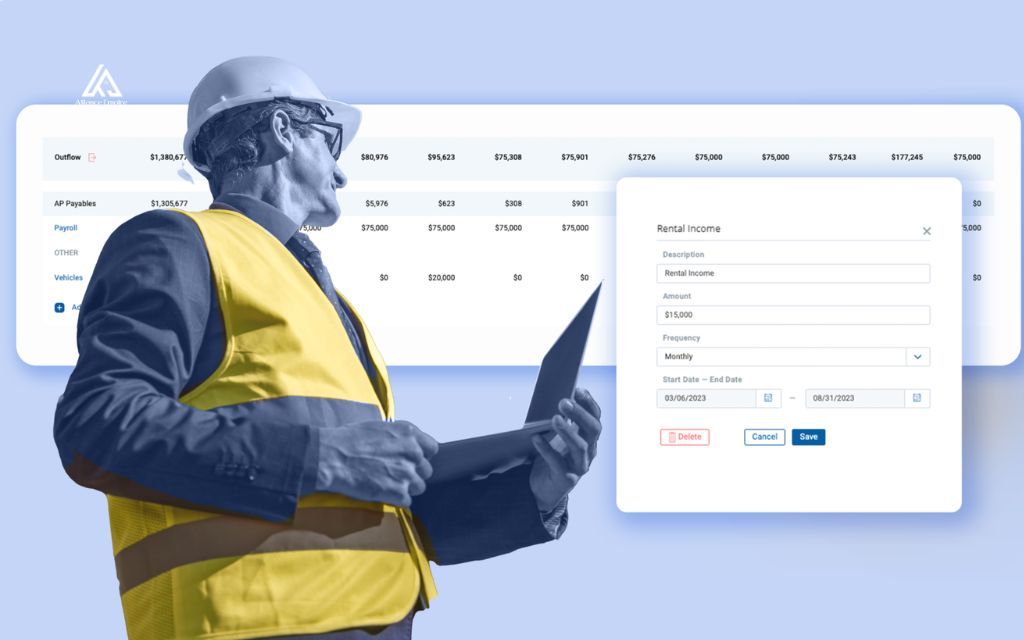
Real-time dashboards pull current cash positions, outstanding receivables, and upcoming payables into a single view instead of requiring manual reconciliation across separate systems, so the forecast reflects today’s numbers rather than data that is already weeks old. Integrated accounting and project management platforms remove the disconnect between field and financial data, updating cost-to-complete estimates and billing status automatically as project conditions change. Scenario modeling tools let finance teams test the impact of a delayed payment, a cost overrun, or a slower bidding season before it happens, a kind of stress testing that takes minutes with the right platform instead of hours by hand.
None of these tools replace the underlying discipline of accurate WIP reporting and realistic assumptions. They simply make it faster to keep a forecast current as conditions change.

Best practices to keep a forecast accurate
Two habits separate contractors who forecast well from those who build a forecast once and let it go stale.
- Cross-team collaboration: Project managers see schedule changes, change order status, and cost overruns before accounting does, while accounting sees payment timing and financing constraints that project managers often lack visibility into. Leaving either perspective out tends to produce a forecast that misses whatever that side would have caught.
- Scenario stress testing: Testing on a regular cadence, not only after a problem appears, shows leadership how much cushion the company actually has if a major client payment slips or a bid season runs slower than expected. Running these scenarios routinely turns forecasting into a proactive planning tool instead of a reactive one.
Conclusion
Accurate construction cash flow forecasting is what turns project backlog and reported profit into a business that can actually fund its own operations. The contractors who forecast consistently, using solid WIP data, realistic collection assumptions, and a rolling update cadence, are the ones who avoid the payroll scramble and the expensive short-term financing that comes with poor visibility.
Alliance EDS has spent over 15 years managing construction and property improvement projects across Denver and Colorado, and that same discipline around planning, communication, and dependable execution applies to how projects are scoped, scheduled, and delivered on budget. Call (720) 484-8181 to speak with our team.
Frequently asked questions (FAQs)
How far ahead should a construction cash flow forecast look?
Most contractors maintain a rolling forecast covering six to thirteen weeks for near-term liquidity planning, alongside a longer six to twelve month view for broader financing and hiring decisions. Both should be updated regularly rather than treated as a one-time exercise.
How often should a forecast be updated?
At minimum monthly, though many active contractors update weekly or biweekly given how quickly billing status, change orders, and project schedules can shift.
Does percentage of completion accounting affect cash flow forecasting?
Yes. Because revenue and taxable income can be recognized before the related cash is actually collected, forecasts need to account for the timing gap between earned revenue and available cash, particularly around estimated tax payments.
Can a small contractor benefit from formal cash flow forecasting?
Smaller contractors are often more exposed to timing gaps because they operate with thinner cash reserves, which makes forecasting arguably more valuable for them than for larger firms with bigger cash cushions.
How does accurate forecasting affect bonding capacity?
Sureties evaluate working capital and liquidity discipline when setting bonding limits. Contractors who can demonstrate consistent, accurate cash flow forecasting typically present lower risk, which can support access to larger bonding limits and larger contracts.