


Scope of work construction documents tell every party what a project includes, who performs each task, and when the work is due. Whether an owner is writing for general contractors or a contractor is writing for subcontractors, the scope of work (SOW) turns drawings and specifications into work that can be priced and assigned.
This guide covers what a construction SOW is, who writes it, what it should include, and how to write one step by step. It also explains inclusions and exclusions, scope gaps and scope creep, and how to manage changes after award.
What is a construction scope of work?
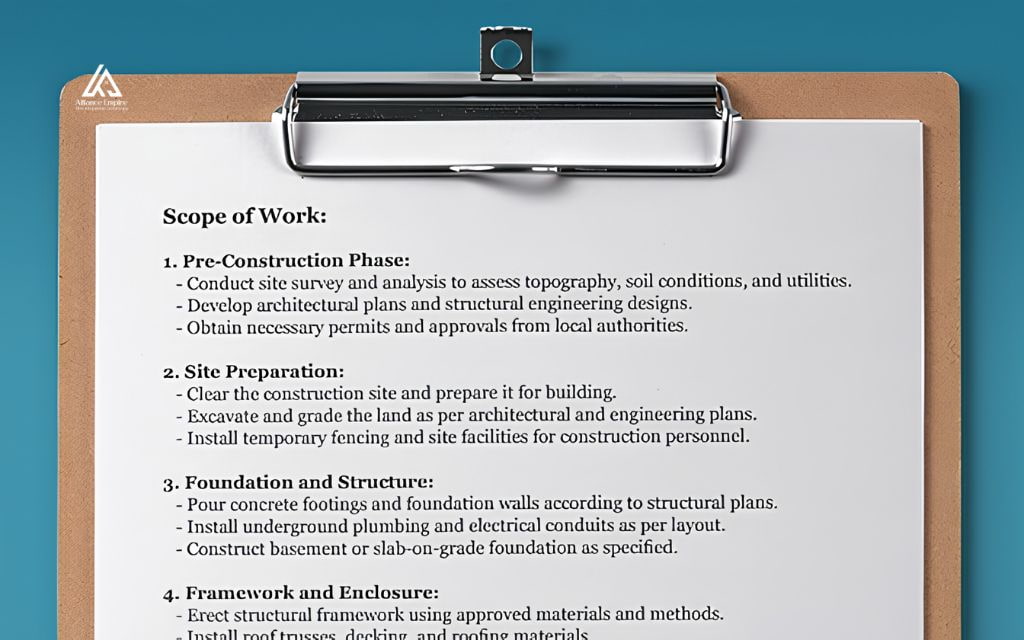
The construction scope of work is the written description of what one party agrees to build or install for another. It lists the activities, deliverables, responsibilities, and deadlines tied to an agreement, so everyone prices and performs the same work.
Drawings and specifications describe the design, while the SOW describes the work covered by the agreement. Drawings show locations and dimensions, and specifications set material and workmanship requirements. The SOW points to both and assigns the resulting work to a party.
These documents should be coordinated rather than treated as interchangeable. Many contracts include an order of precedence clause that says which document controls in a conflict.
Scope of work construction language is usually one part of a larger contract, so its wording must match the contract documents. Some teams use statement of work for the broader package that also covers schedule and administrative terms. Precision matters most on lump sum contracts, where the contractor prices a fixed scope.
Who is responsible for the scope of work?
Scope set by the owner
Owner-level scopes describe objectives, project limits, and expected outcomes. They must be specific enough for contractors to price the work consistently. When the language is vague, bids reflect different assumptions, and bid leveling, the process of comparing bids on an equal basis, becomes guesswork.
The owner’s scope usually sits inside the bid documents alongside drawings and specifications. Bidder questions are answered through clarifications or addenda so every bidder works from the same information.
Scope set by the contractor
General contractors usually break the owner’s scope into trade packages, then write a more detailed scope for each subcontractor or specialty contractor. These packages spell out tasks, materials, methods, and coordination duties for one trade.
Subcontractors shape scope too. Their proposals state what is included, what is excluded, and which assumptions apply, and general contractors compare those statements against the package before award.
What a construction scope of work should include
Required content for scope of work construction documents depends on project size and delivery method, since the scope for a kitchen remodel looks very different from the scope for a highway. Bid-ready documents usually cover these elements:
- Project overview and objectives: The project description, goals, and key definitions.
- Work activities and deliverables: The tasks to perform, quantities or extents where known, and what is delivered at completion.
- Inclusions and exclusions: The work each party must price and the work that belongs to others.
- Responsibilities: Who furnishes, installs, coordinates, and inspects each item.
- Materials and technical requirements: Materials, methods, standards, and references to specification sections.
- Schedule and milestones: Start and completion dates, sequence, and dependencies that affect pricing. The detailed working schedule stays in a separate document.
- Budget and payment terms: The price basis and billing method, often by reference to the contract.
- Quality and acceptance criteria: Inspections, testing, mockups, punch list, and closeout items such as warranties and record drawings.
- Administrative and reporting requirements: Submittals, requests for information (RFIs), meetings, progress reports, and safety requirements.
Inclusions and exclusions in a scope of work
Most scope disputes start with an assumption that one party considered obvious. Listing inclusions and exclusions side by side removes that guesswork. Inclusions state the work a party must price, and exclusions state work that belongs to someone else.
Items that most often need explicit treatment include:
- Permits and fees
- Testing and special inspections
- Temporary facilities and utilities
- Final cleaning and debris removal
- Hazardous material handling
- Owner-furnished materials or equipment
Replace phrases such as “as required” or “and similar” with quantities, locations, or specification references. Clear exclusions protect both sides, because subcontractors can price with confidence and general contractors can see which work remains unassigned.
How to write a scope of work in 3 steps
1. Clarify the project goals
Start by confirming what the project must deliver, for whom, and under what constraints. Write down what success looks like, including required capacity, finishes, performance targets, and fixed dates. Be specific: “improve the lobby” becomes “replace flooring, ceiling, and lighting while keeping the entrance open.”
Bring in the people who will build, review, or price the work early. Construction managers, general contractors, and design professionals can flag missing items while changes are still inexpensive.
2. List the work and requirements
List every activity needed to deliver the goals. Many teams organize the list by CSI MasterFormat division, such as Division 03 concrete, Division 09 finishes, or Division 26 electrical, because the structure matches how specifications and subcontract packages are commonly organized.
For each activity, ask who performs it, where it starts and stops, and which document defines the detail. Add extent, quantities where known, materials, standards, and timeline, and reference specification sections instead of retyping them.
3. Organize by CSI division
Group the final document by division so each trade finds its work quickly and the places where two divisions touch are easier to see. Keep each package readable: one trade, one section, and plain verbs such as furnish, install, and coordinate.
Then review each package against the drawings and specifications, checking that every item belongs to exactly one party. Items in two packages signal overlap, and items in none signal a gap. Finally, state which drawings, specifications, and addenda apply.

Scope gaps and scope creep
Scope gaps and overlaps between trades
Scope gaps are items that no bidder priced, such as sealants between two trades or temporary protection at a shared boundary. Overlaps are items that two bidders priced, which can inflate the combined price.
Gaps usually appear at interfaces, where one trade’s work ends and another begins. Try an interface matrix: list trades along both axes and note who owns the work at each intersection. Blank cells mark potential gaps, and double entries mark potential overlaps.
Scope creep and how to prevent it
Scope creep is the gradual addition of work without a matching change in price or schedule, and it often begins with small verbal requests that seem too minor to document.
Prevention starts with a baseline: a written SOW that everyone has acknowledged. From there, route every request through the contract’s change process, even small ones, so cost and time effects are recorded before the work is performed.

Managing changes to the scope of work
Scopes evolve. Bid questions, design revisions, field conditions, and owner requests can all change the work between bid day and completion. Good change management on scope of work construction projects makes each change visible, priced, and approved in writing.
Changes often begin before award, when bidders submit questions and the owner or design team responds with clarifications or addenda. Treat those questions as a useful signal, though bidders will not catch every weakness. Ambiguity can tempt some bidders to price low and recover cost later through change orders, so independent scope review still matters.
After award, a change order is the usual tool for adding, removing, or modifying work. Standard contract forms typically define who may request a change, how pricing is proposed, and who approves it. Most change sequences follow these steps:
- Document the request and what triggered it.
- Compare the change with the current SOW.
- Price the change and assess the schedule effect.
- Obtain written approval from the party with authority under the contract.
- Issue the change order and update the SOW and related documents.
Conclusion
Scope of work construction documents succeed when they are specific, coordinated with drawings and specifications, and written for the people who must price and build from them. Clear components, explicit exclusions, and a disciplined change process make the SOW a real project control tool.
Planning a project and want a second set of eyes on the scope? Alliance EDS is a Denver, Colorado contractor handling residential and commercial construction, roofing, and renovation work. Call us at (720) 484-8181 to learn more.
Frequently asked questions (FAQs)
What is a scope of work in construction?
It is the written description of the work a party agrees to perform under a construction agreement, including tasks, deliverables, responsibilities, schedule, and quality expectations, alongside the drawings and specifications that carry the design detail.
Is a scope of work legally binding?
The SOW has contractual force when it is incorporated into a signed agreement, usually as an exhibit or part of the contract documents. Drafts nobody has agreed to do not carry that effect. Because enforceability depends on the contract and applicable law, consult an attorney for specific questions.
How detailed should a construction scope of work be?
Detailed enough for qualified bidders to price the work without guessing and for reviewers to compare bids fairly. Fixed-price work generally needs more detail than cost-plus work. Referencing drawings and specifications keeps the SOW concise and avoids contradictions.
Who is responsible for scope gaps between trades?
Responsibility depends on the contract language. In many projects the general contractor coordinates trade packages, but the subcontract and the owner agreement control. Reviewing packages against each other before award is the most reliable way to avoid the question.
What happens when a scope of work is unclear?
Bids become hard to compare, trades may overlap or leave gaps, and disputes become more likely when parties read the same words differently. Resolution typically follows the contract’s clarification and dispute procedures, which is slower and costlier than fixing the wording before award.
Can the scope of work change after the contract is signed?
Yes. Changes are handled through the contract’s change procedure, typically with a written change order that adjusts scope, price, schedule, or all three. Informal agreements outside that procedure make later disagreements harder to resolve.
Do small projects need a written scope of work?
Yes. Even a one-page scope helps on a small remodel or repair. Listing tasks, materials, exclusions, and completion expectations gives the property owner and the contractor a shared reference and makes later changes easier to price.