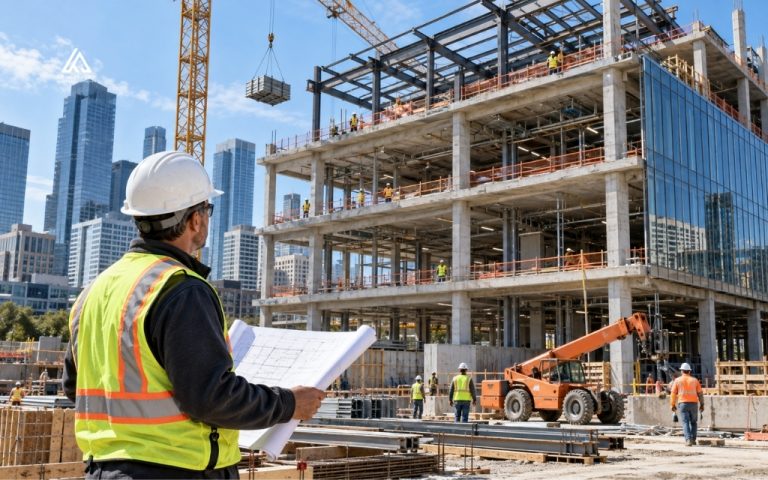


Construction projects rarely fail because of one single mistake. Most delays build up slowly, through disorganized task sequencing, unclear dependencies, and schedules that cannot show which activities actually control the finish date. The CPM schedule solves this problem by mapping every activity, its duration, and its relationship to other work, then calculating the sequence that determines how fast the project can realistically finish.
This guide breaks down what a CPM schedule is, why the critical path method matters for construction planning, and how the calculation works in practice, including a full worked example that shows how forward and backward pass calculations reveal a project’s critical path.
What is a CPM schedule
The CPM schedule, or critical path method schedule, is a project scheduling tool that identifies every activity required to complete a project, estimates how long each activity takes, and maps the dependencies between them. This matches the standard definition used across scheduling platforms: CPM calculates activity dates and total float from logic relationships and constraints to determine a project’s critical path.
In practice, this produces a network of connected activities where the longest connected sequence, measured in duration rather than importance, sets the earliest possible completion date for the whole project. Every CPM schedule construction teams build follows this same logic, regardless of project size, delivery method, or scheduling software.

Advantages of critical path
Understanding a project’s critical path gives every stakeholder a shared reference point for schedule risk. Superintendents know exactly which activities cannot slip without extending the finish date, while project managers can prioritize labor, equipment, and material deliveries around those activities first.
Because CPM scheduling separates critical activities from non-critical ones, teams gain flexibility elsewhere in the plan. Non-critical activities carry float, the amount of time they can shift without affecting the overall schedule, so schedulers can reassign crews or resequence work without triggering a full project delay.
CPM scheduling also supports faster decision making when problems arise. If a critical activity slips, the project finish date moves by the same amount unless the team compresses a later activity. This visibility lets teams evaluate recovery options, such as adding crews or overlapping shifts, before a delay becomes unrecoverable.
Finally, a well maintained critical path schedule creates a defensible record of project logic. Owners, contractors, and subcontractors can reference the same schedule logic when negotiating changes, evaluating delays, or documenting how scope changes affected the finish date.
Core components of a CPM schedule
Activities and durations
Tasks, also called activities, are the individual units of work that make up a project, such as pouring a foundation or installing rough electrical. Each activity is assigned a duration, the estimated time required to complete it under normal working conditions. Duration estimates typically come from historical production rates, crew size, and site conditions rather than guesswork.
Task dependencies
Dependencies define how activities relate to one another in sequence. Four dependency types appear in nearly every critical path method construction schedule:
- Finish-to-start: the most common relationship, where an activity cannot begin until its predecessor finishes, such as framing starting only after the foundation cures.
- Finish-to-finish: two activities must finish together or in a defined order, such as final inspections finishing alongside closeout documentation.
- Start-to-start: two activities begin together, such as site clearing and erosion control starting on the same day.
- Start-to-finish: a less common relationship where one activity cannot finish until another starts, most often seen in shift-based or phased work.
These four dependency types form the backbone of critical path method scheduling on projects of every size.
Milestones
Milestones mark significant points in the schedule, such as permit issuance, substantial completion, or the start of a new project phase. Unlike activities, milestones carry no duration. They exist to flag progress and give stakeholders a quick way to track schedule performance without reviewing every activity individually.
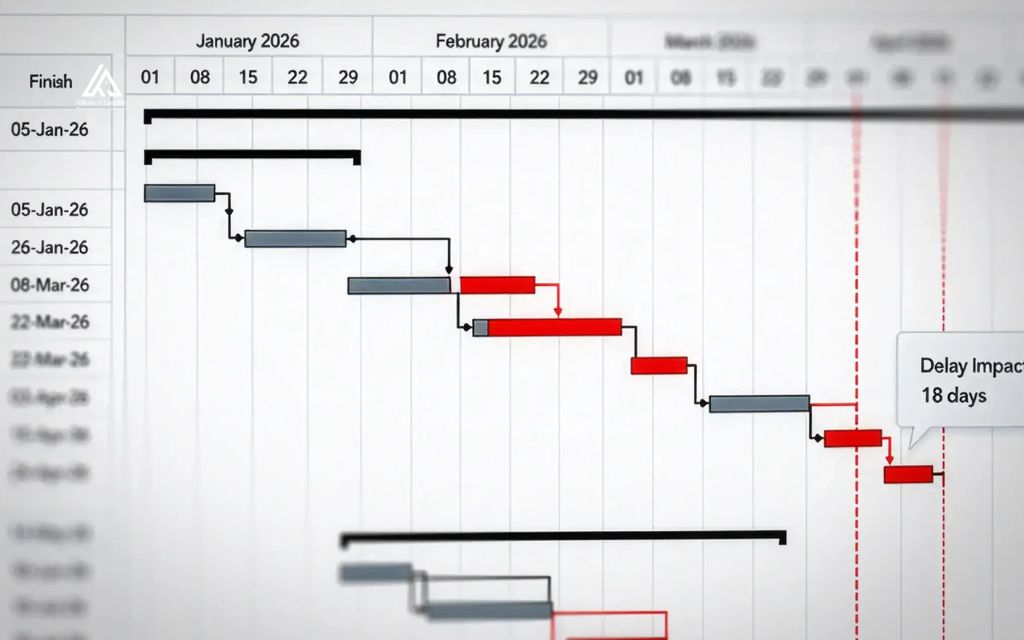
Visualizing the schedule with a network diagram
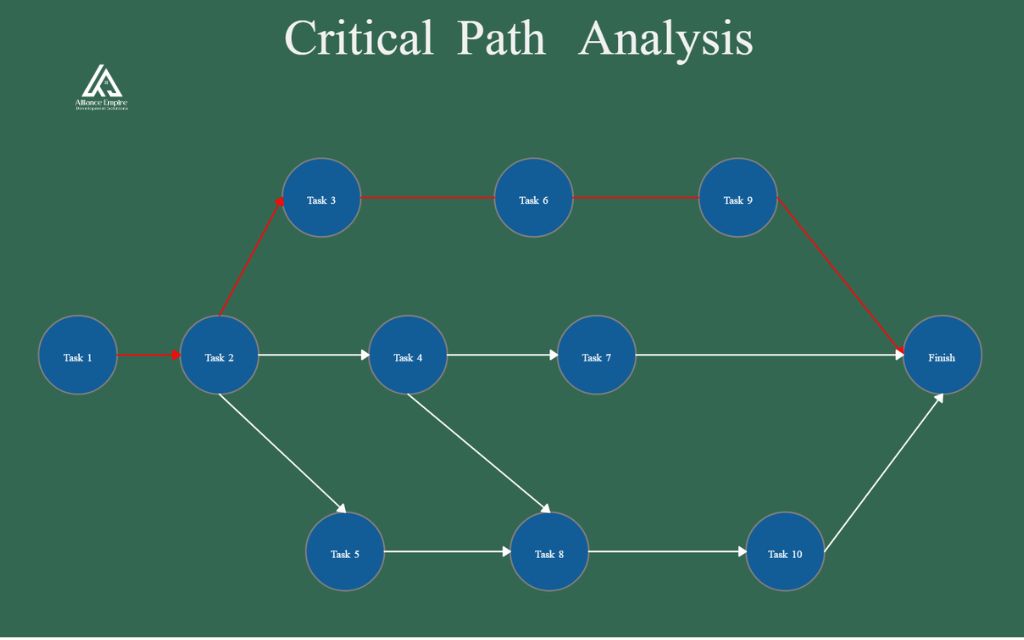
Before a CPM schedule can be calculated, its activities need to be connected in a logic network, often drawn as a precedence diagram or PERT-style network. Each activity appears as a node, and arrows show the dependencies that link one activity to the next.
This network diagram becomes the foundation for the entire calculation. Scheduling software such as Primavera P6 or Microsoft Project builds this network automatically once activities, durations, and dependencies are entered, but understanding the underlying logic helps schedulers catch errors that software alone will not flag, such as a missing dependency or an activity with no logical connection to the rest of the project.
How the critical path method works: A worked example
Forward pass: Calculating early dates
The forward pass moves through the schedule from the first activity to the last, calculating the earliest possible start (ES) and earliest possible finish (EF) for each activity. Each activity’s early finish equals its early start plus its duration, and each activity’s early start equals the early finish of its predecessor.
| Activity | Early start | Duration | Early finish |
| Excavation | Day 0 | 5 | Day 5 |
| Foundation | Day 5 | 10 | Day 15 |
| Framing | Day 15 | 15 | Day 30 |
| MEP rough-in | Day 30 | 12 | Day 42 |
| Finishes | Day 42 | 8 | Day 50 |
Backward pass: Calculating late dates
The backward pass runs in the opposite direction, starting from the project finish date and working back to the first activity. It calculates the latest possible finish (LF) and latest possible start (LS) each activity can have without pushing the overall finish date past day 50.
| Activity | Late finish | Duration | Late start |
| Finishes | Day 50 | 8 | Day 42 |
| MEP rough-in | Day 42 | 12 | Day 30 |
| Framing | Day 30 | 15 | Day 15 |
| Foundation | Day 15 | 10 | Day 5 |
| Excavation | Day 5 | 5 | Day 0 |
How to identify the critical path
The critical path is not simply a list of a project’s most important tasks. It is the sequence of logically connected activities whose combined duration is longest, controlling the finish date. Activities like final inspections can matter greatly yet fall outside this path when float exists.
In the worked example above, every activity carried zero float, making the entire sequence critical. Real projects rarely work this way. Most schedules run several activities in parallel, such as site utilities alongside interior framing, so only one path ends up critical while others carry float.
To find the critical path in a real schedule, calculate total float for every activity through the forward and backward pass, then trace the connected activities where float equals zero from start to finish. That connected sequence is the true critical path.
Conclusion
Building a CPM schedule turns a simple activity list into a fully calculated project plan, complete with early dates, late dates, and a defined critical path that controls the finish date. Once a scheduling team understands how the forward pass, backward pass, and float calculations work together, tracking schedule risk and protecting the completion date becomes far more manageable, whether the project involves five activities or five hundred.
Alliance EDS brings this same scheduling discipline to every construction, renovation, and property improvement project we manage in Denver and across Colorado. Call (720) 484-8181 or visit allianceeds.com to talk with our team about how a well built schedule keeps your next project on time and on budget.
Frequently asked questions (FAQs)
What does CPM stand for in scheduling?
CPM stands for critical path method, a scheduling technique that maps every project activity, its duration, and its dependencies to calculate the sequence controlling the earliest possible finish date.
What does a CPM schedule look like?
Most CPM schedules appear as a Gantt chart or network diagram, showing each activity’s start and finish dates alongside the dependencies linking it to other work in the project.
How to build a CPM schedule?
Building a CPM schedule starts with listing every activity, estimating durations, and identifying dependencies. From there, a forward and backward pass calculates early and late dates, revealing which activities form the critical path.
What is float in a CPM schedule?
Float is the amount of time an activity can shift without delaying the project finish date. Activities with zero float sit on the critical path, while activities with float have scheduling flexibility.
Is CPM scheduling used outside of construction?
Yes. While CPM scheduling is widely used in construction, the same method applies to manufacturing, aerospace, IT projects, and any work made up of sequenced, dependent activities.