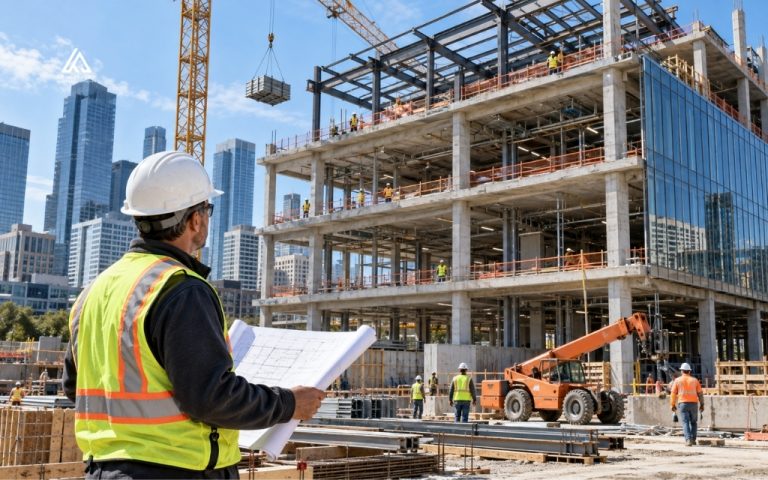


Every building starts as an idea held by a few people and ends as the work of dozens of organizations. Understanding the stakeholders construction project teams deal with, from owners and lenders to inspectors and neighbors, helps keep decisions moving and expectations realistic. Each party brings its own goals, deadlines, and concerns, and the work goes more smoothly when those are known early.
This guide explains who the stakeholders are, how they are classified, and what each group typically needs from the work. It also covers how delivery methods change relationships, how to identify and map stakeholders, and how to manage them with a simple, repeatable plan.
What are stakeholders in a construction project?
Stakeholders in a construction project are the individuals, groups, and organizations that can affect the work or are affected by it. The Project Management Institute (PMI) goes a step further and includes anyone who simply believes the project affects them. That matters on a jobsite, because perception shapes behavior just as much as fact does.
The stakeholders construction project teams must account for reach well beyond the people on site. Lenders who fund monthly payments, inspectors who sign off on framing, and business owners next door who lose street parking for months all hold a stake, even though none of them swing a hammer.
Identifying stakeholders early matters because each one influences scope, budget, schedule, or risk. Overlooked utility owners can stall excavation. Late-joining end users can trigger redesign. Surfacing these parties during planning, when changes are inexpensive, is far easier than reacting after concrete is poured.

Types of stakeholders in a construction project
Stakeholders are sorted in several ways, and each classification answers a slightly different question. Teams often use more than one, depending on what they need to decide.
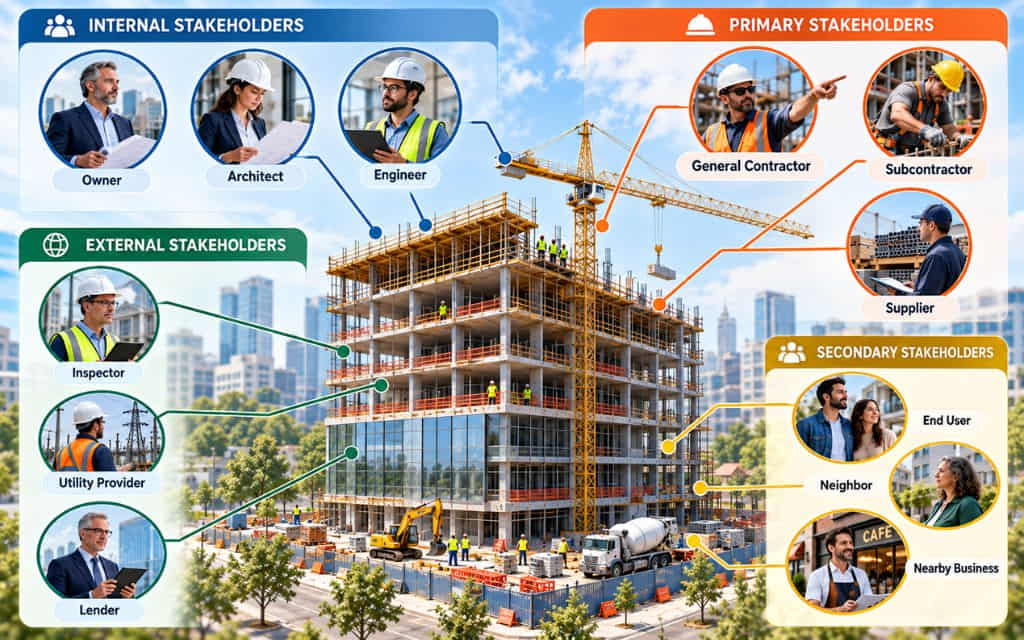
Internal stakeholders
Internal stakeholders take part directly in delivering the project and sit inside the contractual or organizational chain. They include the owner, the owner’s project team, the design team, the general contractor, subcontractors, and suppliers under contract. Their decisions and performance shape daily progress, so they usually need frequent, detailed communication.
The line between internal and external depends on viewpoint. For a contractor, the owner is a customer outside the company. For the owner’s team, the contractor is an outside party hired to perform the work.
External stakeholders
External stakeholders sit outside the project team yet are affected by the work or able to influence it. Examples include building officials, utility providers, neighbors, nearby businesses, community groups, and the traveling public.
They rarely attend progress meetings. Even so, they can approve permits, close a lane of traffic, or raise concerns that slow the work, which makes them important to plan for.
Primary and secondary stakeholders
Primary stakeholders have a direct stake in the outcome and cannot be removed without changing the project itself. The owner, lender, designer, and builder fall into this group. Secondary stakeholders influence or are touched by the project without being essential to delivery, such as neighbors or trade associations.
Secondary does not mean unimportant. One unresolved neighbor complaint can still create delays, so these parties deserve a place in the plan.
Some teams also label stakeholders as supportive or resistant. That view helps decide where extra listening or explanation is needed, as long as the labels are revisited when circumstances change.
Key stakeholders and what each one does
The table below summarizes the stakeholders construction project owners and builders encounter most often, along with what each party usually cares about. Exact responsibilities vary with the contract and the delivery method.
| Stakeholder | Main role | Main interest |
| Owner or developer | Commissions and funds the project, makes final decisions | Value, budget, schedule, and a finished building that fits its purpose |
| Owner’s representative | Manages the project on the owner’s behalf | Protecting the owner’s interests and keeping decisions on track |
| Lender or investor | Provides financing | Repayment, return, controlled risk, and progress visibility |
| Surety | Issues performance and payment bonds when required | The contractor’s ability to finish the work and pay its bills |
| Architect and engineers | Design the building and its systems | Design intent, code compliance, and timely information |
| General contractor or construction manager | Builds the project and coordinates the trades | Profitability, schedule control, safety, and clear scope |
| Subcontractors and suppliers | Perform specialty work and deliver materials | Prompt payment, clear drawings, site access, and sequencing |
| Building department and inspectors | Review plans, issue permits, and inspect work | Code and safety compliance |
| Utility providers | Supply and connect services | Safe, coordinated connections and relocations |
| Insurers | Cover project risks | Risk control and fewer claims |
| End users and facility managers | Occupy, operate, and maintain the building | Usability, performance, and long-term operating cost |
| Neighbors and community | Live or work near the site | Limited disruption and safety |
Owners, developers, and funders
Owners set the project’s purpose, budget, and quality expectations, and they hold final decision authority. On larger projects, owners often hire an owner’s representative, a professional who manages the project on their behalf and serves as the main contact for the designer and builder. Developers may also be the owner, and many put extra weight on schedule and market timing.
Lenders and investors supply the capital, and construction loans are typically released in stages as work is completed and verified. Because of that structure, funders pay close attention to progress reports, change orders, and schedule risk. Sureties join many projects by issuing performance and payment bonds, which give owners recourse if a contractor cannot finish or pay its bills.
Design professionals
Architects shape the building’s layout, appearance, and function, and under traditional delivery they often administer the construction contract for the owner. Structural, mechanical, electrical, plumbing, and civil engineers design the systems that make the building safe and workable. Specialty consultants, such as geotechnical or fire protection experts, add depth where the project calls for it.
Design professionals depend on timely owner decisions and complete information from the field. Slow answers to design questions, or unclear requests for information (RFIs), can ripple through the schedule.
Builders and trade partners
The general contractor builds the project in line with the contract documents, coordinates the trades, manages safety, and controls cost and schedule. Under a construction manager at risk arrangement, the construction manager also advises during design and often commits to a guaranteed maximum price. Subcontractors perform specialized work such as concrete, framing, roofing, electrical, and plumbing, while suppliers deliver the materials and equipment those trades install.
Trade partners depend on clear scope, accurate drawings, access to the work area, and prompt payment. Because one trade’s finish line is the next trade’s starting line, coordination among them is a stakeholder issue as much as a technical one.
Authorities, insurers, and the community
Building departments and other authorities having jurisdiction (AHJs) review plans, issue permits, and inspect completed work against adopted codes. Utility providers connect or relocate water, power, gas, and communications services. Underground lines must be located before digging, which is why contacting 811, the national call-before-you-dig number, is a standard first step.
Insurers underwrite coverage such as builder’s risk and liability policies, and they care about site safety and risk control. End users and facility managers eventually live with the result, so their input on layout, maintenance access, and building systems helps prevent costly rework after handover.

Stakeholders affected without choosing to be
Some stakeholders never signed a contract or attended a meeting, yet the project changes their daily routine. Neighbors, nearby businesses, and the public are the clearest examples, and they are easy to overlook for exactly that reason.
What disruption looks like
Neighbors and nearby businesses typically experience a project as noise, dust, truck traffic, lane or sidewalk closures, and changes to parking and access. They have no seat at the meeting table and often receive no advance warning. When those conditions are ignored, complaints can reach building officials and slow the work.
How to keep neighbors informed
Practical steps are simple and inexpensive. The list below covers the basics.
- Send written notice before disruptive activities such as demolition, crane work, or large concrete pours.
- Share expected work hours and the general schedule.
- Post a phone number or email address for questions and concerns.
- Respond to concerns quickly and explain why the work is happening.
- Follow up after major activities to confirm conditions have returned to normal.

How delivery methods change stakeholder relationships
Choosing among project delivery methods decides who holds contracts with the owner, when the builder joins, and how information flows. The table below compares four common approaches.
| Delivery method | Owner’s contracts | When the builder joins | Typical communication flow |
| Design-bid-build | Separate contracts with the designer and the contractor | After design is complete and the project is bid | Much of the construction-phase communication runs through the architect |
| Design-build | One contract with a single design-build entity | At the start, with design and construction under one team | Owner works through one point of contact |
| CM at risk | Separate contracts with the designer and the construction manager | During design, for preconstruction services | Owner, designer, and construction manager collaborate early, and the construction manager manages trade contracts |
| Integrated project delivery | Often one multiparty agreement among owner, designer, and builder | Very early, as a core team member | Shared decision-making among core parties with common goals |
How to identify and analyze stakeholders
Work on the stakeholders construction project teams must engage is most useful when it starts at project inception and gets revisited at each phase. The cast changes as the project moves from planning to design, permitting, construction, and closeout.
Build a stakeholder register
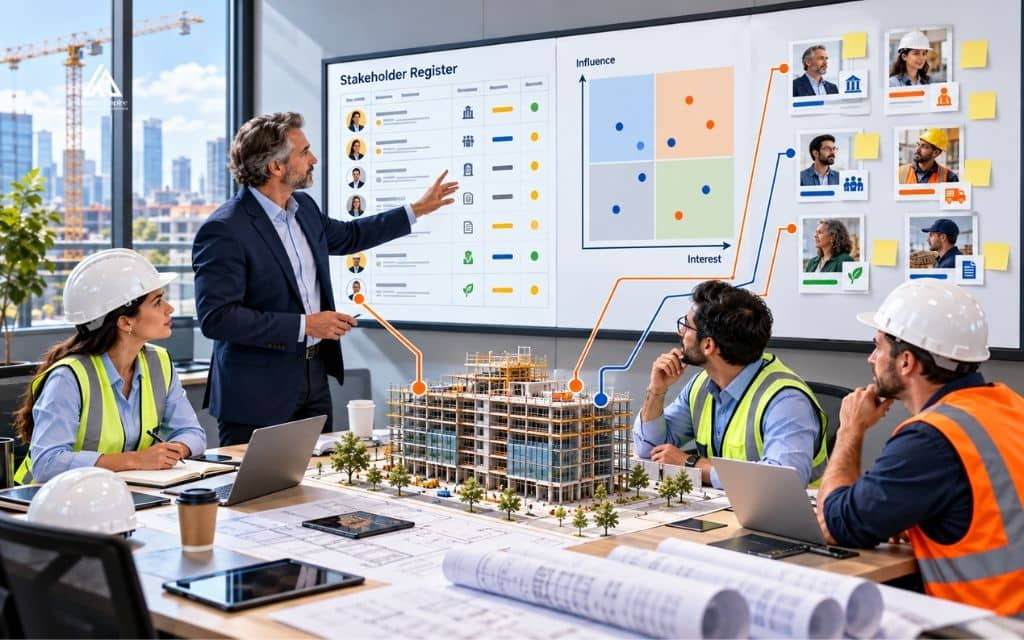
Teams track every identified party in a stakeholder register, a living document that holds the details needed to engage each one. Typical fields include name and organization, role, contact information, main interests, expectations, level of influence, and the team member responsible for the relationship.
Starting with the project team and asking each member who else they work with usually surfaces external parties quickly. Records from similar past projects in the same jurisdiction can also reveal recurring regulators and utilities.
Map influence and interest
The influence and interest grid, often credited to Aubrey Mendelow, sorts stakeholders into four groups and suggests how closely to engage each one. The groups below include sample construction examples, which will vary by project.
- High influence and high interest: manage closely. Owners, lenders, and the general contractor usually belong here.
- High influence and lower interest: keep satisfied. Building officials, utility providers, and insurers often fit this group.
- Lower influence and high interest: keep informed. Neighbors and end users commonly land here.
- Lower influence and lower interest: monitor. The wider public beyond the immediate area is a typical example.
Capture needs, expectations, and risks
Once stakeholders are mapped, teams record what each one needs, expects, and worries about, then connect those items to scope, budget, schedule, and risk. Owners concerned about opening on time tie that concern to the schedule and the purchase of long-lead items. Neighbors worried about early morning noise tie theirs to work hours and permitted activities.
How to manage stakeholders
The stakeholders construction project managers coordinate each need a defined plan for how information flows. PMI frames the work as identifying stakeholders, planning engagement, managing engagement, and monitoring it over time. The steps below turn that into a practical routine.
- Identify every party and add each one to the stakeholder register.
- Analyze influence, interest, needs, and expectations for each group.
- Plan communication by deciding what is shared, how, how often, and by whom.
- Engage through a kickoff meeting, regular progress meetings, and timely updates.
- Monitor and update the plan at each project phase and after any major change.
The communication matrix below shows one simple way to assign messages. The rhythms are illustrative and should be adjusted to project size and contract requirements.
| Stakeholder | What they need | Example method and rhythm | Message owner |
| Owner | Cost, schedule, and decisions needed | Weekly progress meeting and report | Project manager |
| Lender | Progress and payment documentation | Monthly report tied to payment applications | Project manager |
| Design team | Answers to field questions and submittal status | RFI and submittal logs reviewed weekly | Project engineer |
| Subcontractors | Schedule, access, and scope changes | Weekly coordination meeting and short-interval look-aheads | Superintendent |
| Building department | Permits and inspection requests | Requests timed to inspection milestones | Superintendent |
| Neighbors | Notice of disruptive work and a contact path | Written notice ahead of major activities | Project manager |
Common stakeholder challenges and how to handle them
Conflict is normal among the stakeholders construction project managers juggle, because their goals differ. Good teams surface it early and resolve it through documented, transparent decisions.
Conflicting priorities
Owners may want lower cost, designers may want higher quality materials, and builders may want a faster schedule. These goals pull against each other. Naming the project’s top priorities at kickoff, and ranking them, gives the team a reference point when tradeoffs arise.
Late or unclear decisions
Work stalls when nobody is sure who can approve a selection, a change, or a payment. Decision logs that record what was decided, by whom, and when help, as do stated response times for RFIs and submittals. Clear authority levels also keep the same question from bouncing between parties.
Change orders and scope disputes
Change orders are written modifications to the contract that adjust scope, price, schedule, or a combination of them. Disputes usually grow when changes are discussed informally and documented late. Writing up the change, pricing it transparently, and securing the right approvals before work proceeds protects every party.

Best practices for working with stakeholders
Consistent habits keep the stakeholders construction project teams depend on engaged and informed. The practices below apply to projects of almost any size.
- Identify stakeholders during planning and revisit the list at each phase.
- Hold a kickoff meeting to agree on goals, roles, and communication channels.
- Communicate on a set schedule, using the same channels each time.
- Document decisions and approvals in writing.
- Share risks and schedule threats early, while options remain open.
- Assign one named person to each key relationship.
- Close the loop on feedback so people see what happened to their input.
Conclusion
Handling a stakeholders construction project well comes down to a few habits: identify every party early, understand what each one needs, and communicate on a steady rhythm. Owners, designers, builders, regulators, and neighbors all shape the outcome, and the projects that run smoothly tend to be the ones where those relationships were planned rather than improvised.
Planning a build, renovation, or commercial project and looking for a construction partner who treats every stakeholder as part of the team? Alliance EDS is a Denver, Colorado construction and general contracting company serving residential and commercial clients. Call (720) 484-8181 to talk through your project.
Frequently asked questions (FAQs)
Who is the most important stakeholder in a construction project?
No single party is most important in every situation. Among the stakeholders construction project managers work with, the owner holds final authority and funds the work, so owners carry the greatest decision power. Even so, a project can stall when a regulator, lender, or key subcontractor is overlooked. Importance depends on timing, influence, and the issue at hand, which is why mapping stakeholders by influence and interest helps.
What is the difference between internal and external stakeholders?
Internal stakeholders take part directly in delivering the project, such as the owner’s team, designers, contractors, and subcontractors. External stakeholders sit outside the project team yet are affected by the work or can influence it, such as inspectors, utility providers, and neighbors. The dividing line can shift depending on whose viewpoint is used.
What happens when stakeholders are not aligned?
Misalignment tends to show up as unclear scope, slow approvals, repeated rework, and disputes over cost or schedule. Aligning goals at kickoff, documenting decisions, and communicating on a regular schedule reduce those risks. When disagreements still arise, a clear escalation path helps the team resolve them without stopping the work.
How often should the stakeholder register be updated?
There is no fixed rule. The register should be reviewed at the start of each project phase and whenever a major change occurs, such as a new lender, a design revision, a change in ownership, or a new permit condition. Many teams also revisit it during regular project reviews so new parties are captured early.
Can one party hold more than one stakeholder role?
Yes. Developers can be the owner and the eventual end user at once. Design-build firms act as designer and builder under one contract, and some companies serve as a supplier on one project and a subcontractor on another. Recording each role separately in the register keeps responsibilities clear.