

A change order is one of the most common documents in construction, yet it is also one of the most misunderstood. Anyone asking what is a change order is really asking how a project adapts once site conditions, design details, or owner priorities shift after the contract is signed.
This guide covers how a change order works, how it differs from a change directive or supplemental instruction, why changes happen, and what belongs in a properly documented change order, including the approval process and best practices for avoiding disputes.
What is a change order?
A change order is a written modification to an existing construction contract that adjusts the scope of work, the contract price, the completion schedule, or a combination of the three. It is executed after the original agreement has been signed and typically requires signatures from both the owner and the contractor before it takes effect. Once signed, the change order becomes part of the contract, carrying the same legal weight as the original agreement.
Change orders exist because no set of drawings and specifications, however detailed, can anticipate every condition a project will encounter. Design gaps surface, owners refine their requirements, and site conditions differ from what was assumed during bidding. A change order gives both parties a documented, agreed-upon path for handling that shift instead of leaving it to informal instructions or verbal agreements that are difficult to enforce later.
Change order terminology and standard forms compared
Change order vs. CCD vs. ASI vs. PCO
The table below compares how each term is used, who typically issues it, and whether it obligates the contractor to proceed:
| Term | What it is | Who typically issues it | Binding on the contractor? |
| Change order (CO) | Formal, signed modification to price, scope, or schedule | Agreed jointly by owner and contractor | Yes, once fully signed |
| Construction change directive (CCD) | Written order to proceed with a change before cost or time impact is agreed | Owner or architect | Yes, immediately, even without contractor agreement on price |
| Architect’s supplemental instruction (ASI) | Minor clarification or interpretation of the contract documents | Architect | Not for cost or time; a separate CO or CCD is needed if either is affected |
| Proposed change order (PCO) | Preliminary estimate of a potential change, used for review and negotiation | Contractor or owner’s representative | No, it is a draft used to reach agreement |
AIA G701 vs. ConsensusDocs 202 and 795
The two most widely used standard change order forms in the United States are AIA Document G701 and the ConsensusDocs 202 series. AIA G701 is designed for use with the AIA A201 General Conditions and is common on architect-administered, design-bid-build projects. ConsensusDocs 202 serves a similar function within the ConsensusDocs family of agreements, which is frequently used on design-build and construction manager at-risk projects, with ConsensusDocs 795 available as the subcontract-level version.
Both forms capture the same core information, a description of the change, the price adjustment, the time adjustment, and signature lines for authorization, but they reference different general conditions language. Project teams should use whichever form matches the underlying contract family to keep terminology and clause references consistent.
Types of change orders
Not every change order serves the same purpose. Recognizing the type helps clarify how it should be priced and documented:
- Additive change order: Adds scope, cost, or time to the original contract, such as installing an additional system or expanding a building footprint.
- Deductive change order: Removes scope from the contract and reduces the contract price accordingly, often used when an owner eliminates a feature to control budget.
- Unilateral change order: Directed by the owner or architect without the contractor’s prior agreement on price or time, functioning similarly to a construction change directive when work must proceed immediately.
- Zero cost change order: Documents a scope change that has no net effect on price or schedule, commonly used for material substitutions of equal value or administrative corrections.
When and why change orders happen
Work needs a change order any time it deviates from the signed contract documents in a way that affects scope, price, or time. The most common causes include:
- Design errors and omissions: Incomplete drawings, conflicting specifications, or missing details discovered once construction begins.
- Differing site conditions: Subsurface, structural, or existing conditions that differ materially from what the contract documents represented.
- Owner-requested changes: Finish upgrades, layout revisions, or added scope requested after the contract was signed.
- Material cost and availability: Price escalation or supply shortages that require substitutions or price adjustments.
- Code and regulatory updates: New requirements from the authority having jurisdiction that were not in effect when the contract was signed.
- Weather and force majeure events: Conditions that delay work or damage completed work, requiring schedule and sometimes scope adjustments.
- Estimating and bidding errors: Quantity or scope miscalculations identified once work is underway.
What belongs in a change order document
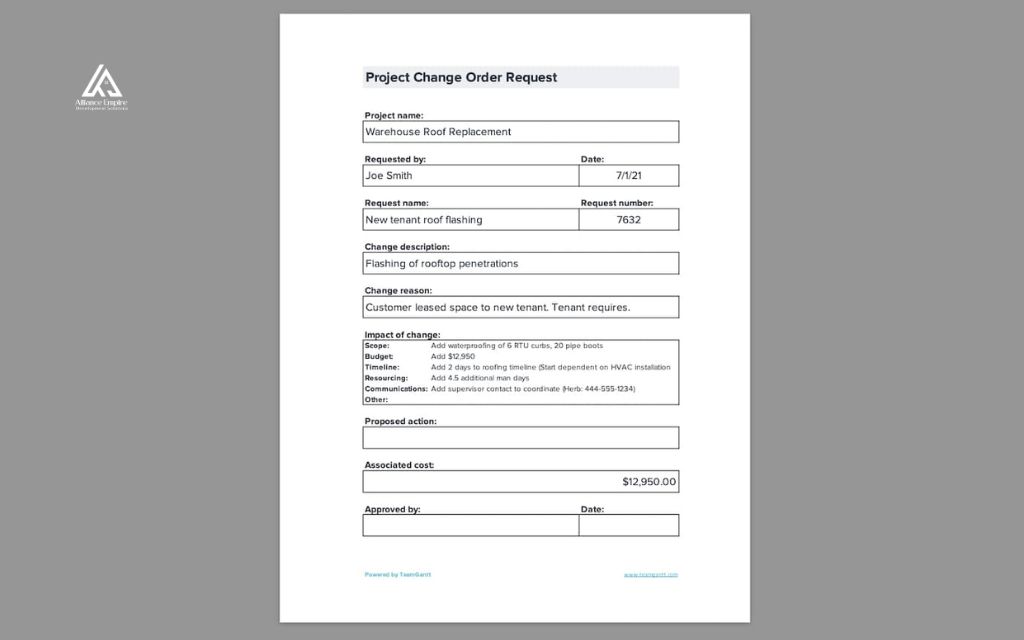
A well-documented change order protects both parties and creates a clear project record. At minimum, it should include:
- Description of the change: The specific scope, materials, or work being added, removed, or modified.
- Reference to the original contract: The contract sections, drawings, or specifications affected by the change.
- Reason for the change: The trigger or cause, documented for the project record and any future dispute resolution.
- Cost breakdown: Labor, material, equipment, and overhead and profit markup, along with the total price adjustment.
- Schedule impact: The number of days added or removed and the revised completion date, if applicable.
- Authorization and signatures: Approval from the owner and contractor, and from the architect or engineer when the contract requires it.

The change order approval process
Most change orders move through a consistent sequence from identification to final sign-off:
- Identify and document the need for change, including the trigger and any supporting evidence such as photos, RFIs, or field reports.
- Prepare a proposed change order (PCO) with a preliminary cost and schedule estimate.
- Submit the PCO for review by the architect, engineer, or owner’s representative.
- Negotiate the scope, price, and time impact until all parties reach agreement.
- Approve and sign the formal change order, converting it into a binding modification of the contract.
- Update project records, including the schedule, budget, and as-built documentation, to reflect the approved change.
How change orders affect cost and schedule
Change order pricing typically follows the markup structure already established in the base contract, applying the agreed overhead and profit percentage to the added or deducted cost. Retainage generally applies to change order values the same way it applies to the base contract, unless the agreement specifies otherwise. Schedule impact is usually only justified when the change affects an activity on the project’s critical path; changes to non-critical activities may not warrant a time extension even if they add cost.

Best practices to avoid change order disputes
The following practices help keep change orders documented, priced, and approved before disagreements have a chance to arise:
- Document everything in writing: Verbal instructions should be confirmed in writing before work proceeds, since undocumented changes are the most common source of disputes.
- Price changes promptly: Delaying cost and schedule negotiation increases the risk of disagreement once work is already complete.
- Track cumulative impact: Monitor how multiple smaller changes affect overall schedule and budget together, not just individually.
- Maintain a clear change order log: Centralize tracking of all pending, approved, and rejected changes so nothing is missed.
- Use standardized forms: Consistent documentation, such as AIA G701 or ConsensusDocs 202, reduces ambiguity and speeds up approvals.
- Communicate early with all stakeholders: Owners, architects, and subcontractors should be aligned on a change before work proceeds whenever possible.
Conclusion
A change order is not a sign that a project went wrong. It is the contractual tool that keeps scope, cost, and schedule aligned as design gaps, site conditions, and owner priorities evolve. Understanding what is a change order and how to document one properly gives every project a clearer path through changes that are bound to happen.
If your project in the Denver area is navigating a complex scope change, Alliance EDS can help review the details before you sign. Reach the team at (720) 484-8181 to schedule a free consultation.
Frequently asked questions (FAQs)
What is a change order in construction?
It is a written, signed modification to a construction contract that adjusts scope, price, schedule, or a combination of the three after the original agreement has been executed.
What is the difference between a change order and a change directive?
A change order requires agreement from both the owner and contractor before it takes effect. A construction change directive lets the owner or architect direct the contractor to proceed with a change immediately, even before price or time impact has been agreed, with the terms finalized later.
What is a constructive change order?
A constructive change occurs when a contractor ends up performing additional or different work because of an owner’s actions, instructions, or delays, even though no formal change order was issued. The contractor is generally still entitled to compensation once the constructive change is documented and proven, but it typically involves more evidence gathering and carries greater dispute risk than a standard, formally approved change order.
Who is responsible for paying for a change order?
Responsibility depends on the cause. Owner-requested changes and differing site conditions are typically funded by the owner, while changes caused by a contractor’s error in performance are typically absorbed by the contractor.
How long does the change order process take?
There is no fixed timeline. Simple, low-cost changes can be documented and approved within days, while complex changes involving design review or significant cost negotiation can take considerably longer.